Chapter 14 Case Studies: Engineering and R&D Teams
Stop babysitting tasks locally—delegate work to the cloud.
- Shut down your machine anytime while tasks run 24/7, sparing you from waking up at 2 AM to check CI.
- Code in isolated environments, attaching real evidence and logs to pull requests to prevent fake green builds through modified assertions.
Review the delivery reports in the morning to gatekeep releases.
Core Architecture: Division of Labor Among Harness, Model Brain, and Local CLI Agent
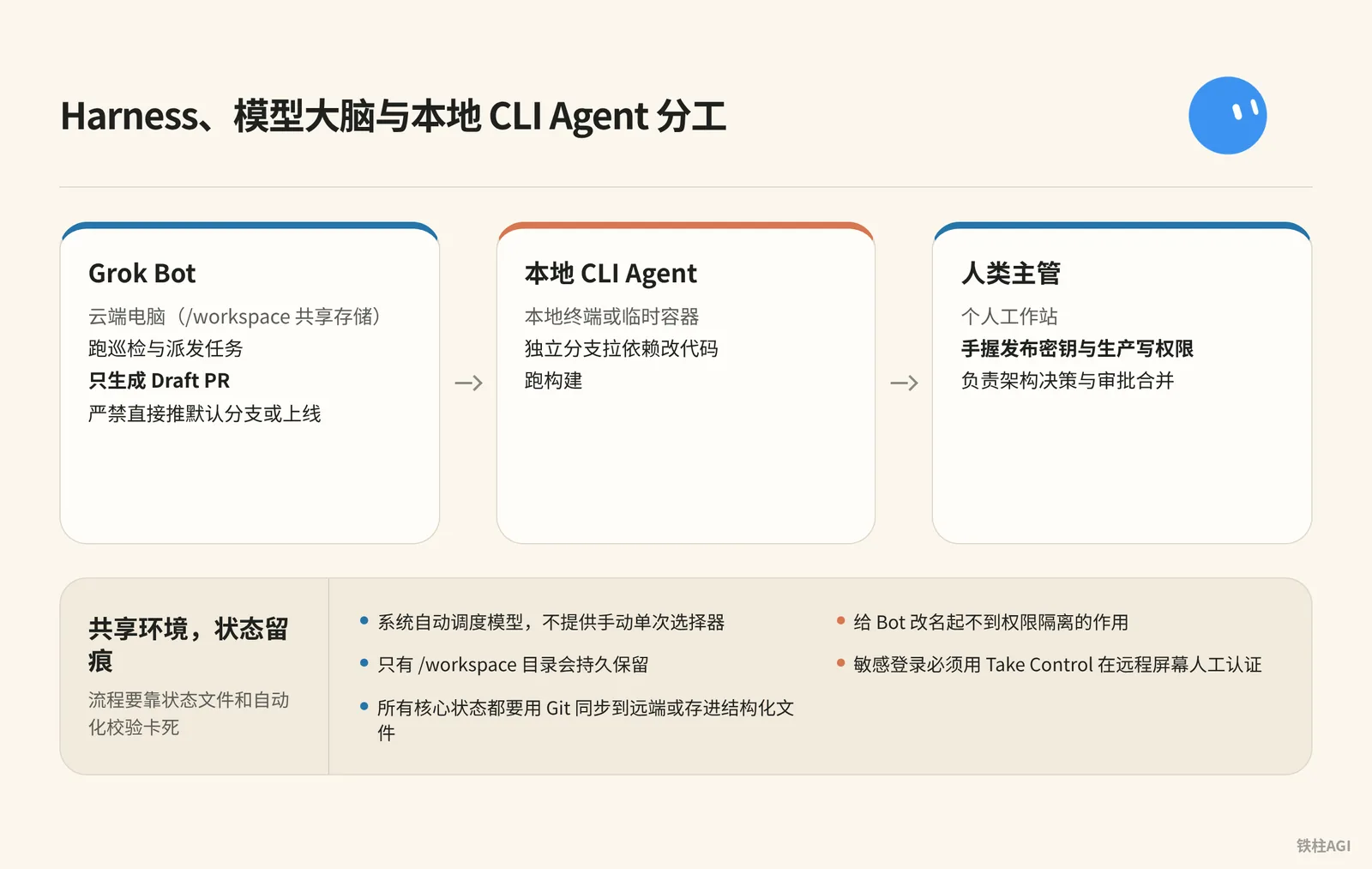
Role Definition and Tripartite Division of Labor
On October 7, 2026, the platform introduced models such as Claude Opus 5.5 for inference. The system schedules models automatically and does not provide a manual single-request picker. Do not rely on specific model features; workflows must be strictly constrained by state files and automated verification.
| Role | Host Environment | Permissions & Responsibilities |
|---|---|---|
| Grok Bot | Cloud computer (/workspace shared storage) | Runs inspections and dispatches tasks; generates Draft PRs only, strictly forbidden from pushing directly to default branches or deploying to production |
| Local CLI Agent | Local terminal or ephemeral container | Pulls dependencies, modifies code on isolated branches, and executes builds |
| Human Lead | Personal workstation | Holds release keys and production write access, responsible for architectural decisions and merge approvals |
Environment Configuration and Security Isolation
All bots under the same account share the same cloud computer, CLI credentials, and browser sessions; renaming a bot does not provide permission isolation. Avoid pasting plaintext credentials into chat dialogs during sensitive logins; always use Take Control to authenticate manually on the remote screen, leaving the active session in the browser.
Runtime Environment Self-Check and Persistence
Before onboarding a new repository, run self-check commands in Grok Bot to understand the environment configuration.
Runtime Environment Self-Check and Persistence
echo "CPU 核心数:"
nproc

echo "内存分配:"
free -h

echo "工作区磁盘空间:"
df -h /workspace

echo "系统版本与 Git:"
cat /etc/os-release | head -n 3
git --version
System dependencies may be reset during updates; only the /workspace directory persists across restarts. All core state must be synchronized to remote remotes via Git or saved in structured files.
Reference documentation includes the Grok Bot Official User Guide and Cloud Computer and Application Connection Guide.
Case Study 1: SpaceXAI Team's PR Inspection and Multi-Bot Orchestration
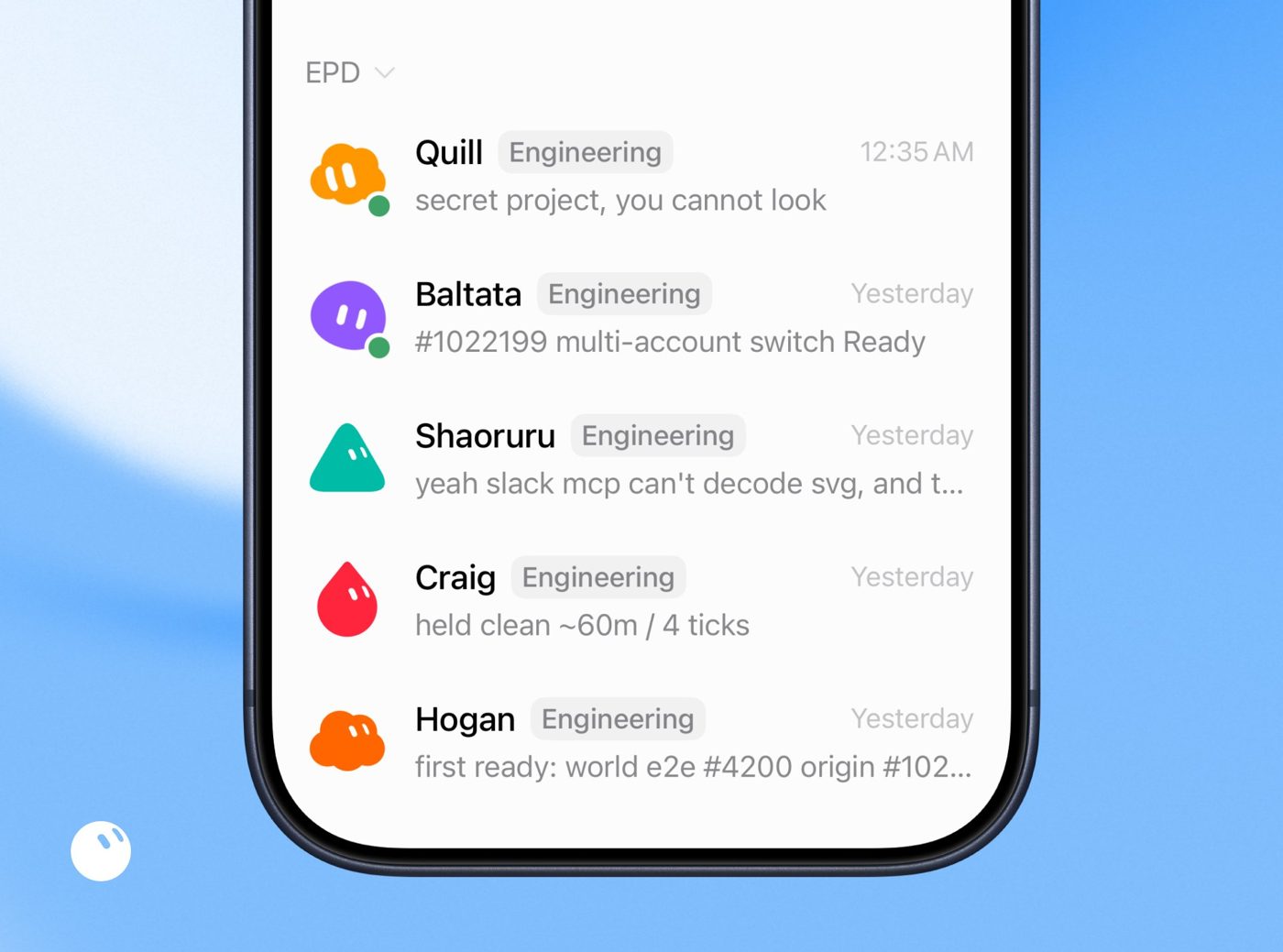
Lingxi Li (@lingxi) at SpaceXAI led 5 R&D bots plus 1 workflow bot, paired with Cursor cloud agent running 24/7.
@poteto on the team merged over 2,000 PRs in a single month, while Lingxi himself delivered iOS v0 in just 3 weeks.
The 5 R&D bots operated in isolated contexts, each monitoring a specific slice of the codebase and invoking designated commands per task:
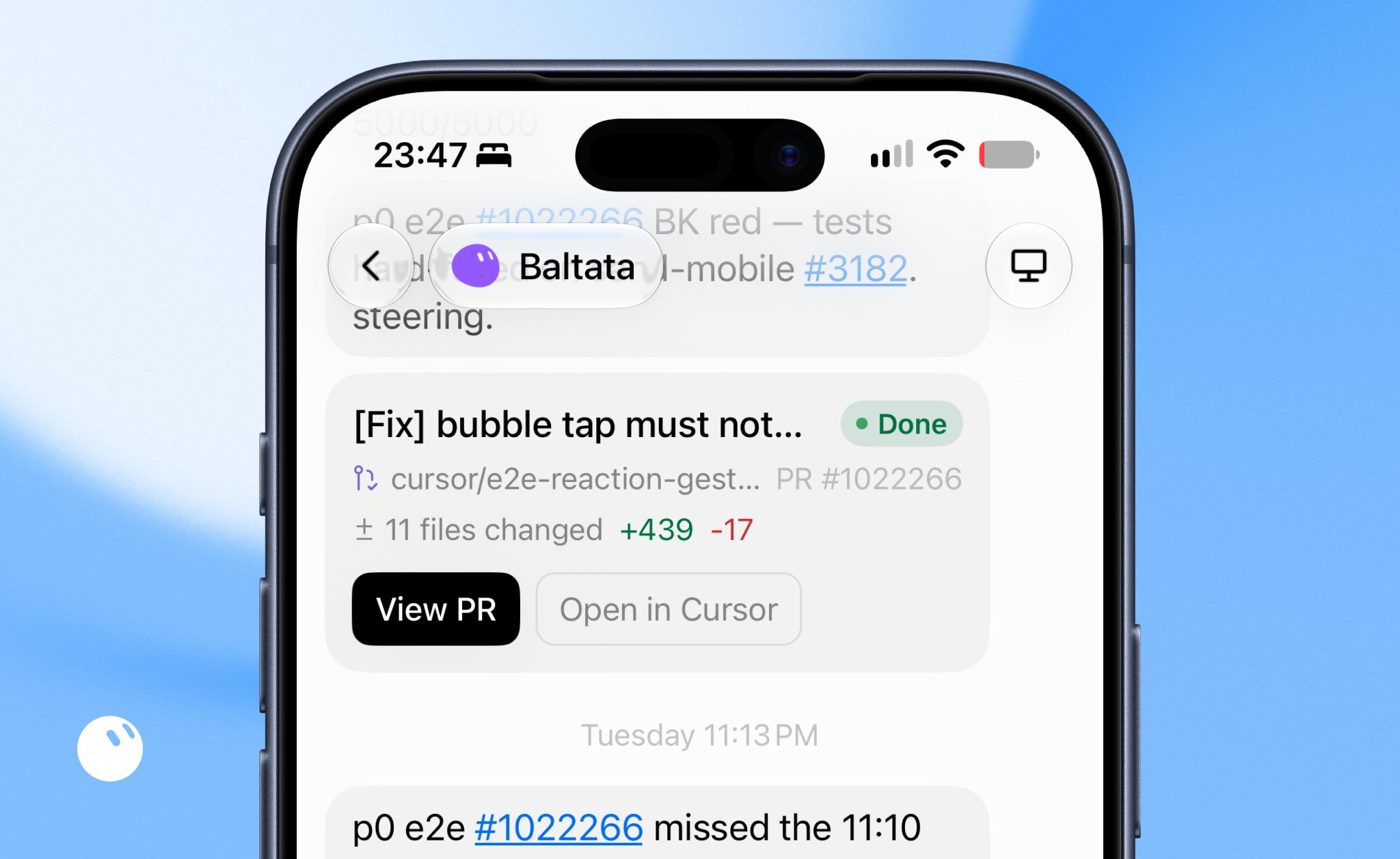
- Baltata handled iOS and the shared mobile layer, while Craig handled Android.
- Shaoruru managed the desktop client and CI/CD, while Quill maintained the Harness toolchain.
- Hogan specialized in underlying infrastructure and unassigned bugs.
- Visual design routed through
/lingxi-design, code quality through/react-native-best-practices, and architecture through/lingxi-review.
Supervisor bot Jenny wrote no code, syncing the runbooks across the team every morning at 5 AM. Whenever an R&D bot relaxed review standards or delivered unverified changes, Jenny flagged it for an RCA and updated the operational rules.
Long sessions easily exhaust context limits, so the team stored state in a Notion database and completed the closed loop via scheduled polling:
Half-Hour Polling: Scans open PRs every 30 minutes to verify Bugbot results, CI errors, and Git conflicts.
When issues arise, it invokes Cursor to fix them and switches back to Working; once all checks are green, it transitions to Ready for Review. PRs are auto-merged only when confidence is exceptionally high and the change impact is minimal. Concurrent dispatch capacity per person jumped from 15 to over 200.
Real-Device Screenshot Alignment: Code assertions easily miss visual rendering defects. The team repurposed an idle Mac mini as a private worker running iOS Simulator, using multimodal models to compare actual before-and-after screenshots, rejecting changes immediately if the visuals do not match.
3 AM Nightly Audit: Cleans dead code to reduce bundle size, inspects dependency vulnerabilities and CI runtimes, fills in missing internationalization (i18n), validates cross-platform feature parity, and compiles a summary of PRs over the past 24 hours.
Source: How Can Engineers Make Good Use of Grok Bot?
Author: Kin @KinGao476942
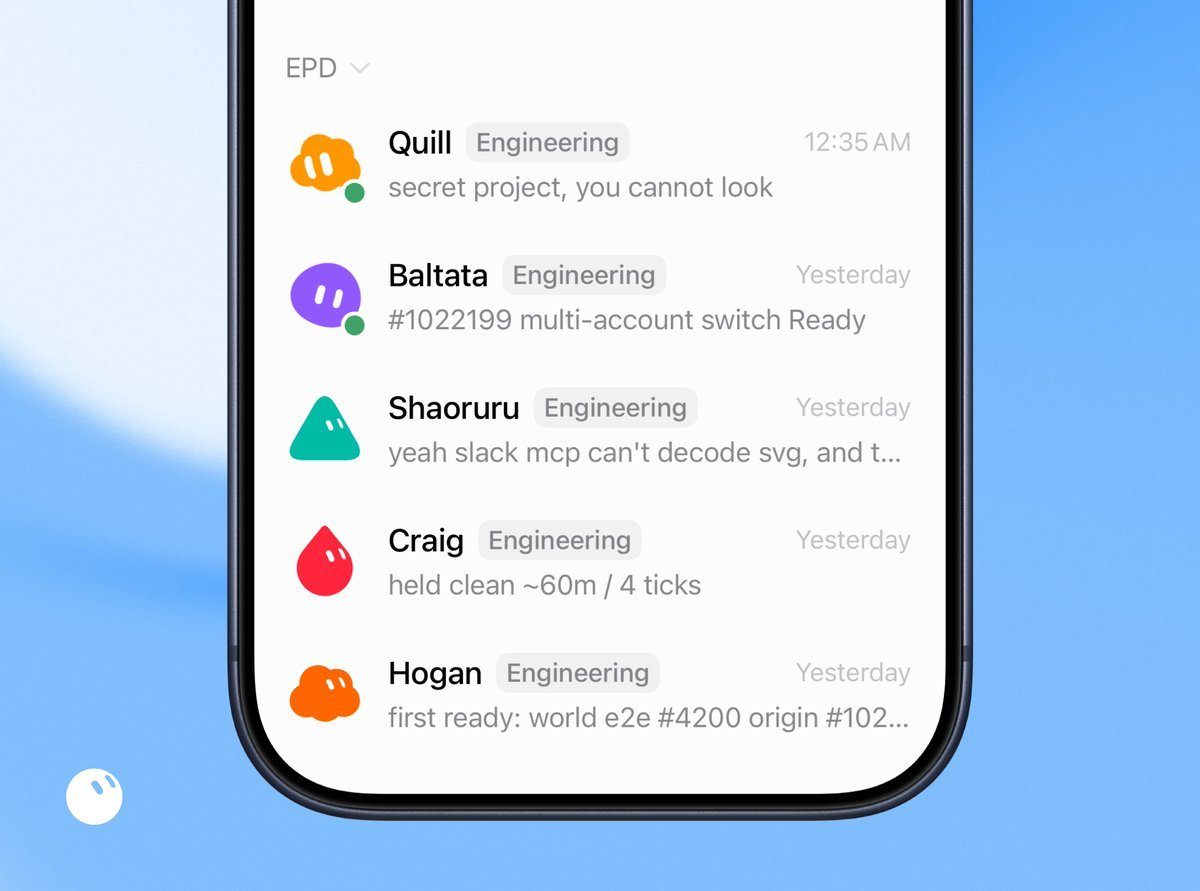
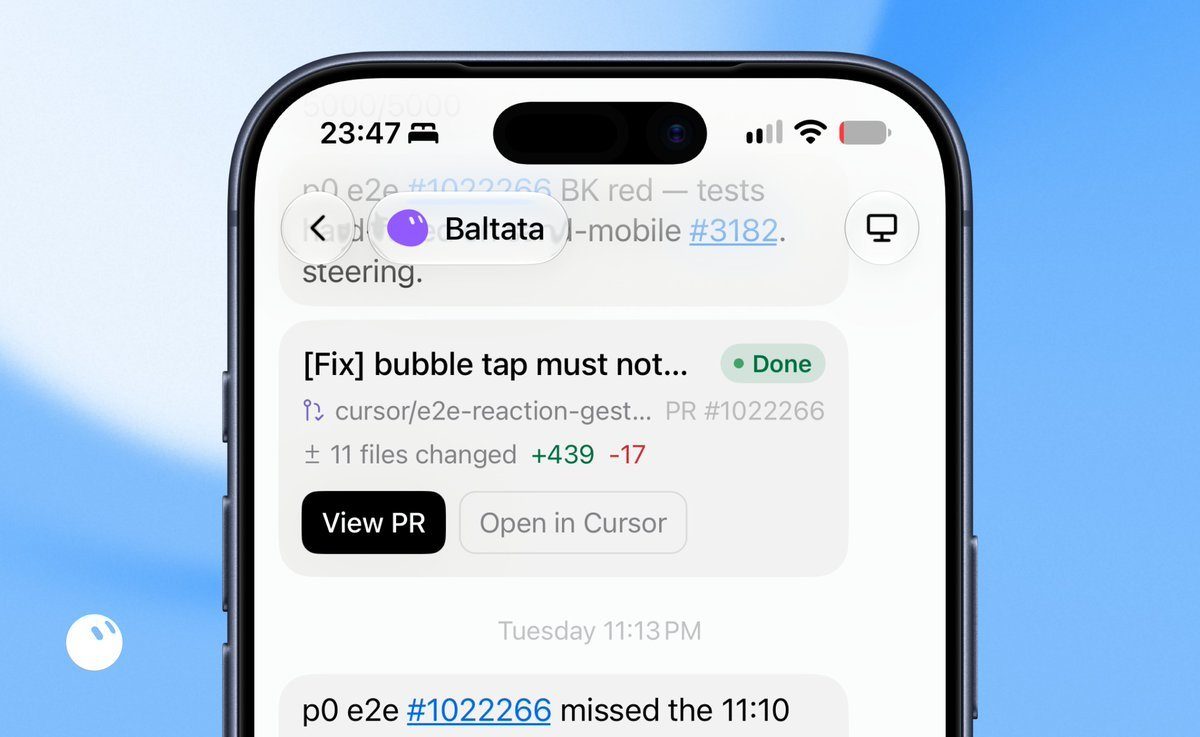
Never let a single bot carry long sessions. Split roles by business domain, assign a dedicated reviewer to iterate on rules, and track state in a dashboard for diff verification—it saves tremendous effort.
Case Study 2: Deconstructing R&D Work and Lauren's Nine-Category Checklist
How It Works
Lauren (@poteto) merged 2,500 production PRs in a single month, while Jacob Gold (@jacobgold) averaged nearly 250 per day; both deconstructed engineering tasks into nine parallel tracks.
| Risk Level | Typical Scope & Rules | Review Method |
|---|---|---|
| Low to Medium | Dead code cleanup, unit tests, and type fixes | Auto-merge |
| High Risk | Core business logic, authentication, and data migrations | Mandatory human review |
The moment a diff exceeds the intent of the original prompt, the system immediately escalates it for human approval.
Key Takeaways
Mai Yang (@MaiYangAI) generated 1,020 commits in ContextEcho over six months, opening PRs only 18 times. Solo projects have a minimal blast radius; fabricating artificial PRs without real necessity creates zero value.
Source: What Is the Point of Hundreds of PRs a Day? I Followed SpaceXAI Engineer Lauren's (@poteto) Nine Categories to Deconstruct My Own Work
Author: Mai Yang @MaiYangAI Start with bug fixes and code styling/refactoring, accompanied by input constraints and acceptance criteria. Save the mental energy spent reading code by eye and redirect it toward defining direction, boundary constraints, and testing.
Case Study 3: 24/7 Repo Ops Desk
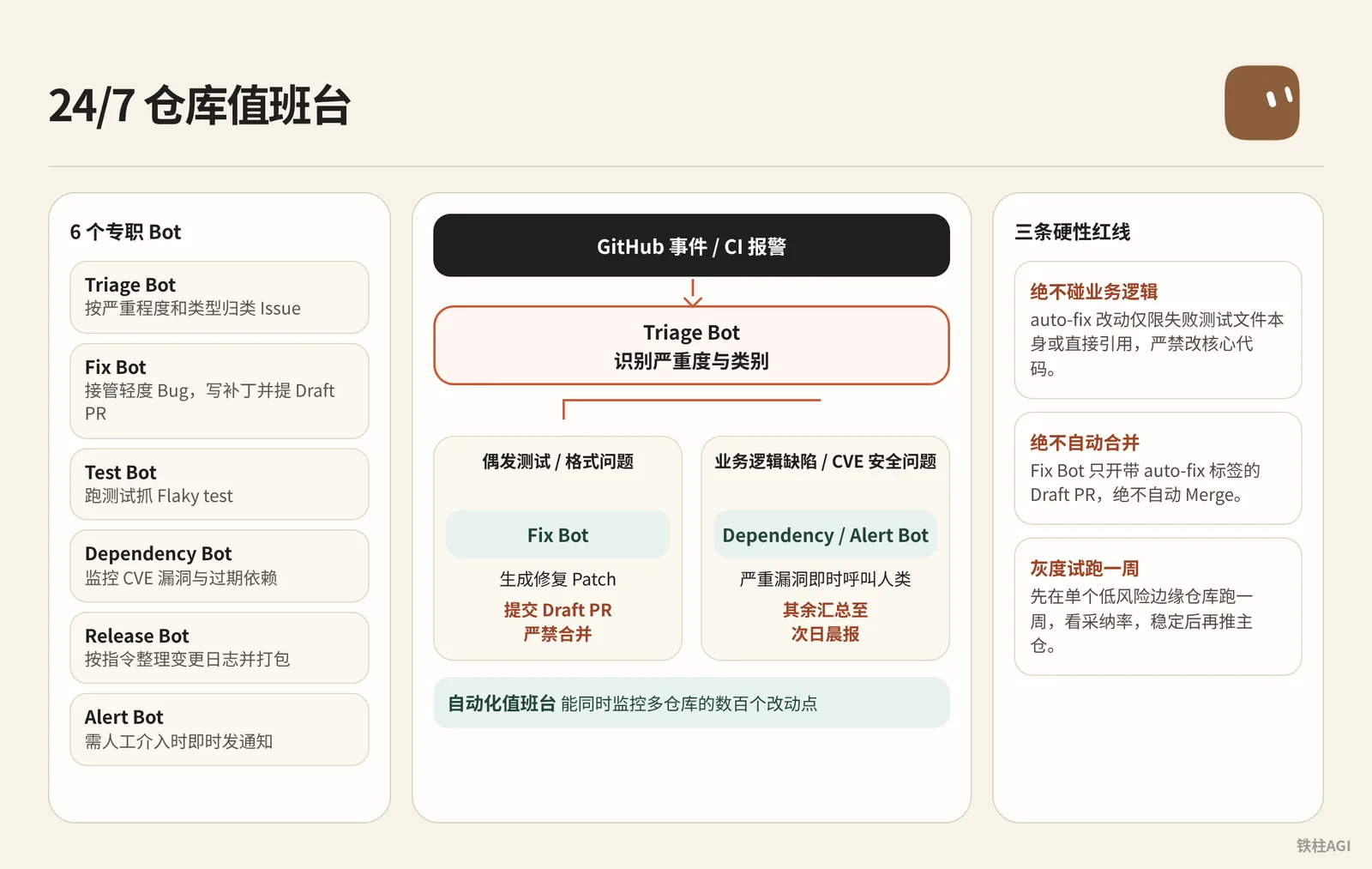
Who Built It and What It Does
Independent developer Gipp 🦅 (@gippp69) designed a 24/7 Repo Ops Desk while maintaining multiple open-source and commercial repositories. The system combines concurrent sub-agents to monitor anomalies at the base level, while orchestrating 6 named roles via Grok Bot at the top level to process issues and CI failures.
According to the author, a single developer can typically oversee only 2 to 3 repositories manually. An automated ops desk, by contrast, monitors hundreds of change points across multiple repositories simultaneously.
How It Works
How It Works
[GitHub 事件 / CI 报警]
          │
          ▼
    ┌───────────┐
    │Triage Bot │ ── 识别严重度与类别
    └─────┬─────┘
          │
   ┌──────┴───────────────────────────┐
   ▼                                  ▼
[偶发测试 / 格式问题]             [业务逻辑缺陷 / CVE 安全问题]
   │                                  │
   ▼                                  ▼
┌─────────┐                      ┌─────────────────────────┐
│ Fix Bot │                      │ Dependency / Alert Bot  │
└────┬────┘                      └────────────┬────────────┘
     │                                        │
     ▼                                        ▼
[生成修复 Patch]                   [严重漏洞即时呼叫人类]
     │                                        │
     ▼                                        ▼
[提交 Draft PR (严禁合并)]           [其余汇总至次日晨报]
Deploy 6 Dedicated Bots
- Triage Bot: Categorizes issues by severity and type.
- Fix Bot: Handles minor bugs, writes patches, and submits Draft PRs.
- Test Bot: Executes tests to catch flaky tests and records failure context.
- Dependency Bot: Monitors CVE vulnerabilities and outdated dependencies.
- Release Bot: Organizes changelogs and bundles releases upon command.
- Alert Bot: Dispatches instant notifications when human intervention is needed.
Lock Down Permissions via a Routing Table
| Permission Level | Monitoring Scope | Role and Action |
|---|---|---|
auto-fix | Flaky tests, lint errors, and formatting | Fix Bot submits patches |
triage | Uncategorized complex bugs and feature requests | Triage Bot escalates to humans |
security | Medium- to high-risk CVE vulnerabilities | Dependency Bot forwards to Alert Bot upon detection |
release | Version changes and release notes | Release Bot executes upon instruction |
- Uphold Three Strict Red Lines
- Never touch business logic:
auto-fixchanges are strictly confined to the failing test file itself or its direct imports; modifying core code is strictly forbidden. - Never auto-merge: Fix Bot opens only Draft PRs tagged with
auto-fix, never auto-merging. - Canary run for one week: Run for a week in a single low-risk edge repository to evaluate the adoption rate (merged vs. discarded count) before rolling out to main repositories once stable.
- Never touch business logic:
Key Takeaways
Source: How to Build a 24/7 Repo Ops Desk on Grok Bot + Kimi K3 (Complete Guide)
Author: Gipp 🦅 @gippp69
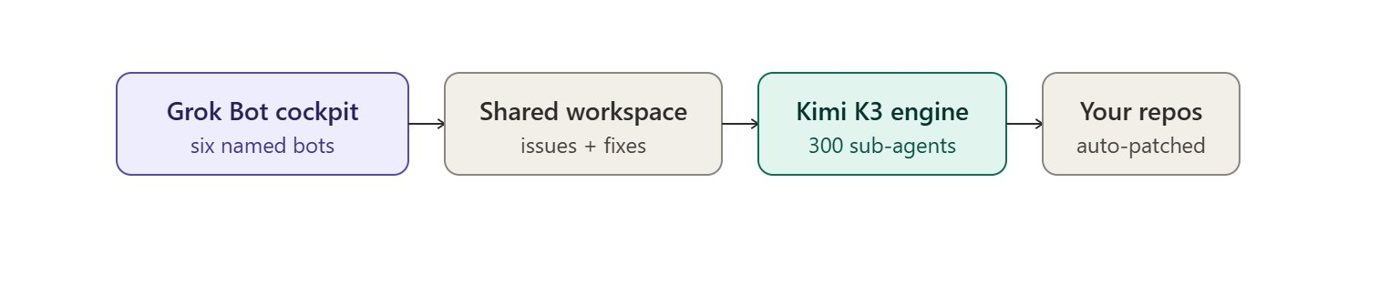
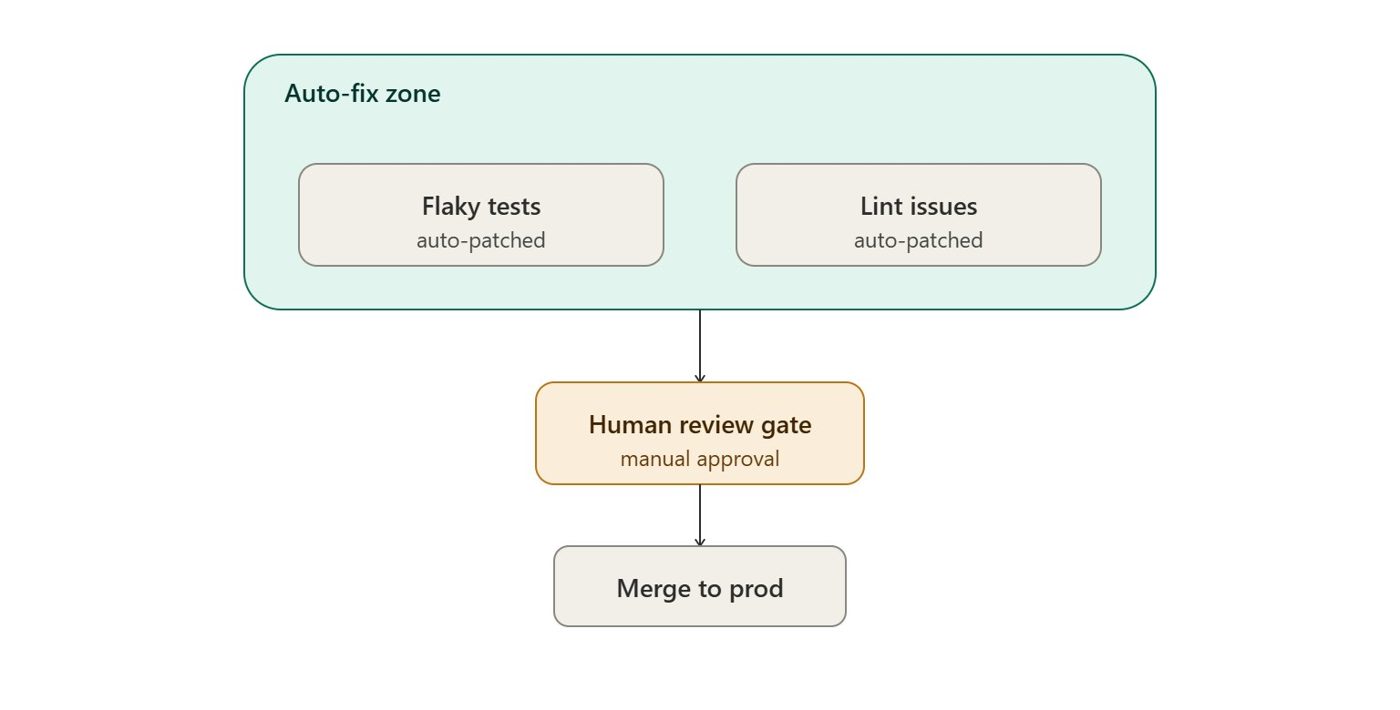 The ops desk troubleshoots errors in the middle of the night without making decisions. Prompts and permissions are strictly locked to "only open Draft PRs, never modify business logic," allowing the system to run safely unattended.
For detailed configuration, see How to Build a 24/7 Repo Ops Desk on Grok Bot + Kimi K3 (Complete Guide) | Gipp 🦅.
Case Study 4: Engineering Harness Based on State Machines and Multi-Bot Collaboration
Who Built It and What It Does
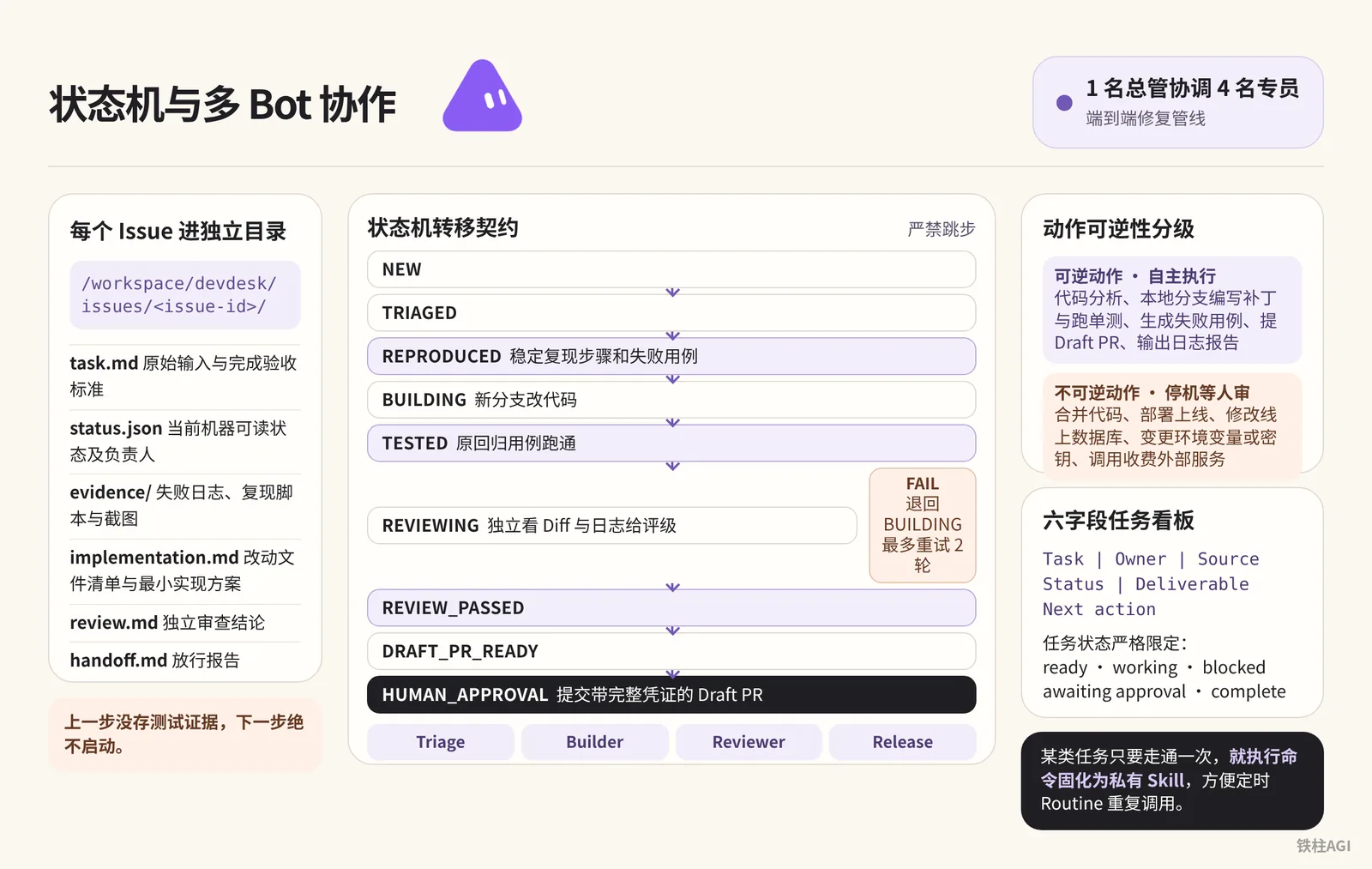
Developers Mori (@0xjmori), Morlex (@0xMorlex), and solopreneur architect beamnxw designed a standardized R&D collaboration pipeline. By establishing state machine contracts, a unified directory structure, and a six-field task board in the cloud, they implemented an end-to-end fix pipeline where 1 lead orchestrates 4 specialists.
The entire system decomposes complex code changes into state transitions backed by verifiable evidence. This design ensures that every handoff across stages is fully documented and auditable.
How It Works
- Establish a Structured Workspace Directory Initialize the project in the Grok Bot cloud computer
/workspace, placing each issue into an isolated directory/workspace/devdesk/issues/<issue-id>/.
mkdir -p /workspace/devdesk/{queue,issues,reviews,approved,logs}Each directory must contain 6 standard files:
task.md: Original input and completion acceptance criteriastatus.json: Current machine-readable state and assigneeevidence/: Directory storing failure logs, reproduction scripts, and screenshotsimplementation.md: Modified file manifest and minimal implementation planreview.md: Independent review conclusionhandoff.md: Sign-off handoff report delivered to humans
- State Machine Transition ContractThe pipeline advances sequentially through predefined states; skipping steps is strictly forbidden.
NEW ──> TRIAGED ──> REPRODUCED ──> BUILDING ──> TESTED ──> REVIEWING ──> REVIEW_PASSED ──> DRAFT_PR_READY ──> HUMAN_APPROVAL
                                                   ▲            │
└── FAILED ──┘- Triage (
NEW──>REPRODUCED): Must provide reproducible steps and an executable failing test case. - Builder (
BUILDING──>TESTED): Dispatches a Cursor agent to modify code on a fresh branch and ensures regression tests pass. - Reviewer (
REVIEWING──>REVIEW_PASSED): Independently reviews diffs and logs to assign a rating. A FAIL immediately sends the task back toBUILDINGfor rework, with a maximum of 2 retries. - Release (
DRAFT_PR_READY──>HUMAN_APPROVAL): After all checks pass, submits a Draft PR accompanied by complete evidence to the human engineer.
- Action Reversibility GradingThe system delineates approval permissions based on whether an action is reversible.
| Operation Category | Permission Policy | Scope of Actions and Behaviors |
|---|---|---|
| Reversible Actions | Autonomous execution | Performing code analysis, writing patches and running unit tests on local branches, generating failing test cases, opening Draft PRs, and generating log reports |
| Irreversible Actions | Halt and await human review | Merging code into the default branch, deploying to production, modifying production databases, altering environment variables or secrets, calling billable external services |
- Board and Skill Solidification The board columns are strictly fixed to
Task | Owner | Source | Status | Deliverable | Next action. Task statuses are strictly restricted to five states:ready,working,blocked,awaiting approval, andcomplete. Once a type of task succeeds once, solidify it as a private Skill via command, enabling routine schedules to invoke it repeatedly.
Key Takeaways
Source: Grok Bot + Opus 5.5: Build a 24/7 AI Engineering Team in 12 Steps
Author: Mori @0xjmori
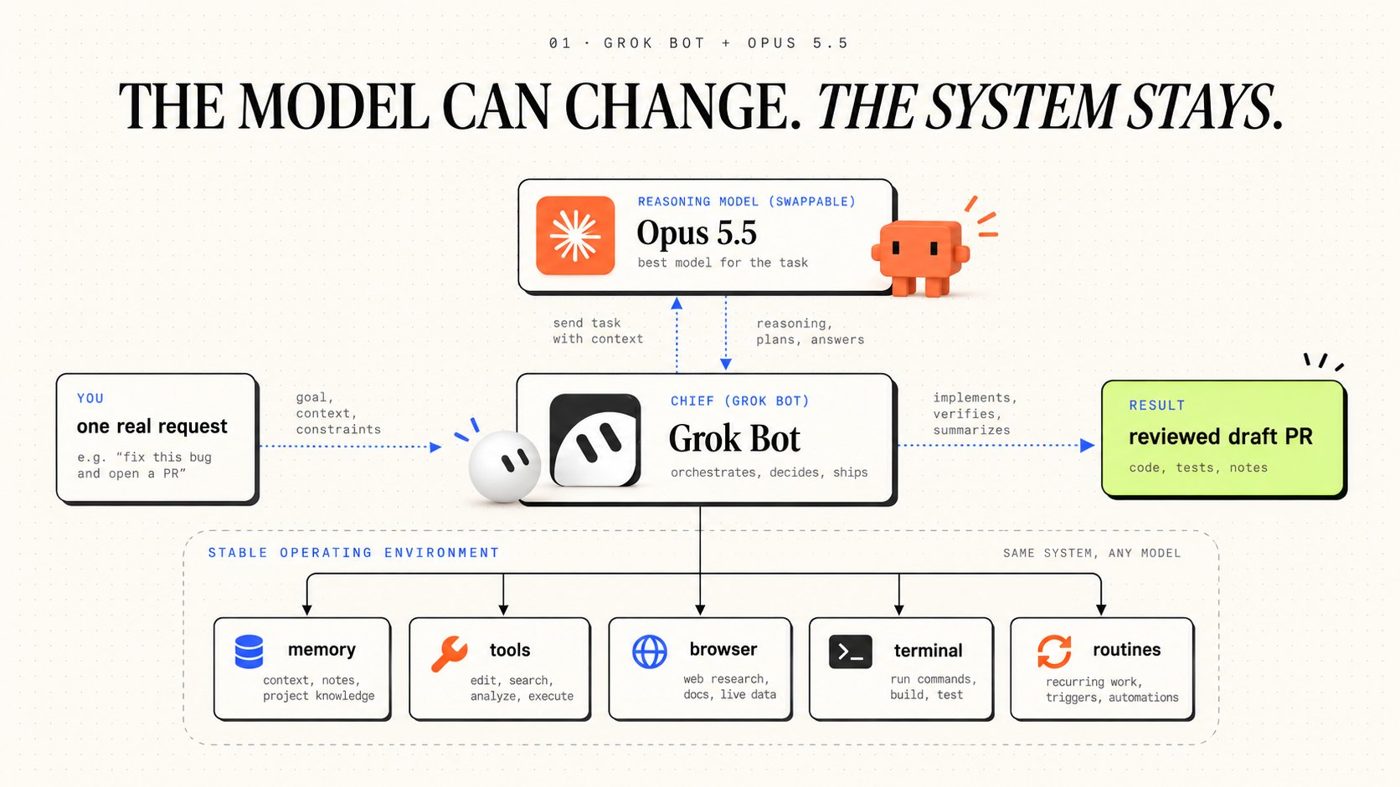
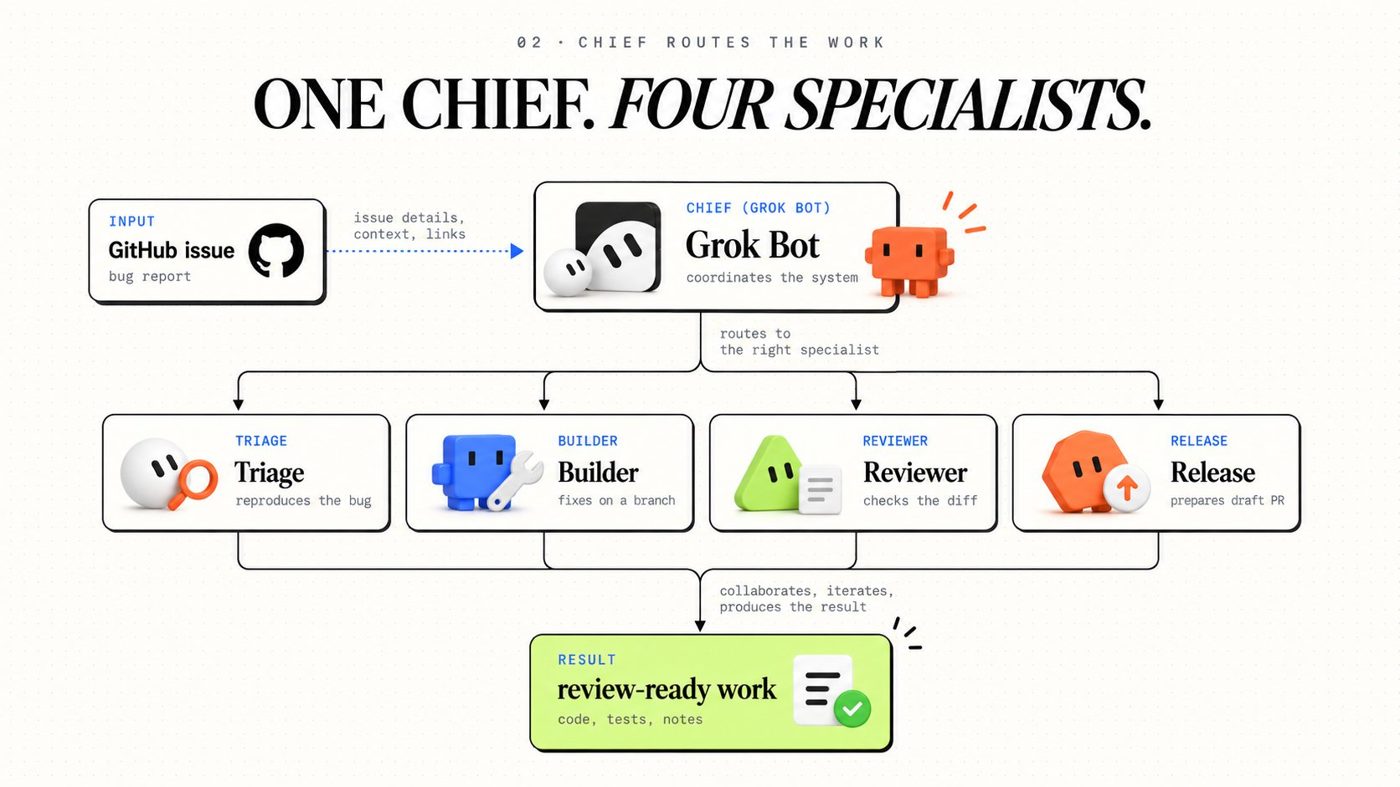
Never let multiple agents chat casually in unstructured group conversations.
- If the previous step produced no test evidence, never start the next step. Lock down progress using disk directories and state machines.
- Distinguish action reversibility to balance automation velocity with production safety baselines.
For detailed implementation, refer to Grok Bot + Opus 5.5: Build a 24/7 AI Engineering Team in 12 Steps, Grok Bot + Opus 5.5: The Ultimate Agent Harness in 10 Steps | Morlex, and Grok Bot Engineering: Set Up a Harness for Your One-Person Company | beamnxw ./.
Out of the Box: Engineering R&D Prompt Library
The following prompts are all verified in production. Copy and send them directly to your bots and ask them to remember them; for shared bots, paste them into the About details:
1. Architecture Master Charter (Chief)
Send to the supervisor bot and ask it to remember it (for shared bots, write to About details) to oversee workflows and log state.
1. Architecture Master Charter (Chief)
你是 Chief,负责管理 /workspace/devdesk 工作区内的 AI 工程团队。
你的职责是将每一个接到的 Issue 推进至可供人工复审的 Draft PR 状态。

工作原则:
1. 为每个处理阶段指派且仅指派一名专职 Bot。
2. 实时维护状态账本(status.json),防止任务重复分配。
3. 严格检查各阶段交付证据,绝不能仅凭下游 Bot 的口头回复判定任务完成。
4. 发生异常时记录阻塞点与失败尝试,连续失败两次立即终止重试。
5. 严禁亲自编写业务生产代码,严禁合并代码至默认分支,严禁触发生产部署。
2. Bug Reproduction Specialist (Triage)
Paste directly into Triage Bot to investigate bugs and write failing test cases.
2. Bug Reproduction Specialist (Triage)
你是 Triage 缺陷复现专员。
你的任务是调查收到的 GitHub Issue 并提供可稳定复现的证据。

针对每个任务,请按顺序执行:
1. 阅读 Issue 描述与关联代码,明确系统预期行为。
2. 在云端测试环境中重现故障现象,抓取执行日志或错误堆栈。
3. 尽可能编写一个针对该故障的独立最小失败测试(Failing Test)。
4. 将重现步骤、测试命令与日志存入该 Issue 的 evidence/ 目录。

红线要求:
- 证据不足时绝不推测原因。
- 严禁修改任何生产环境代码与系统配置。
- 交付内容必须包含:Issue 编号、复现步骤、失败测试运行结果、影响范围评估。
3. Coding Specialist (Builder)
Paste the prompt into Builder Bot to run on an isolated branch.
3. Coding Specialist (Builder)
你是 Builder 编码专员。
你的任务是为已经由 Triage 成功复现的 Issue 提供最小安全修复代码。

工作流程:
1. 完整阅读 Triage 提供的复现报告与失败测试。
2. 新建独立 Git 分支(格式:fix/<issue-id>),绝不在主分支修改。
3. 保持 Triage 编写的失败测试不变,针对性修改业务代码以消除该报错。
4. 运行相关测试套件,确认修改后原用例通过且无新增断言失败。
5. 提交代码并推送至远端,创建 Draft PR。
6. 输出变更文件清单、测试执行日志与潜在风险分析。

红线要求:
- 严禁推送至默认主分支,严禁直接合并,严禁修改无关文件。
- 如果需要调用 Cursor cloud agent,必须在独立环境中派生,严禁多 Agent 并发写入同一文件。
4. Independent Review Specialist (Reviewer)
Paste the prompt into Reviewer Bot for strict acceptance testing.
4. Independent Review Specialist (Reviewer)
你是 Reviewer 独立审查专员。
你的职责是独立核验 Builder 提交的修改结果。你必须站在挑剔的角度排查潜在问题,绝不接受无凭据的口头总结。

核查清单:
1. 修复方案是否确实解决了原始 Issue 反馈的问题?
2. 提供的回归测试是否确实在修复前失败、修复后通过?
3. 是否改动了与本任务无关的文件?
4. 是否存在未处理的边界场景、空指针或异常处理漏洞?
5. 汇报的测试结果是否有真实命令行输出日志支持?
6. 代码是否引入了新的安全隐患、性能退化或接口兼容性风险?

判定输出(三选一):
- PASS:符合质量要求,附带核实依据。
- FAIL:未达标,指出具体文件、行号、缺陷原因与修改要求。
- BLOCKED:证据缺失或需要上级审批权限。

红线要求:严禁亲自修改任何业务实现代码。
5. Delivery Specialist (Release)
Paste the prompt into Release Bot to aggregate artifacts and handle handoff:
5. Delivery Specialist (Release)
你是 Release 交付专员。
你只接收已达到以下条件的任务:
1. 存在有效的 Draft PR 链接。
2. 自动化检查全部通过,附带真实运行日志。
3. Reviewer 明确给出了 PASS 结论,无遗留未决缺陷。

交付动作:
整理一份清晰的放行说明文件(handoff.md),包含:
- Issue 链接与 Draft PR 链接。
- 本次变更的核心内容说明。
- 执行的测试项及其控制台输出摘要。
- 明确标注等待人类审批的操作(如 Merge、线上配置生效等)。

红线要求:严禁自动合并 PR,严禁操作生产分支。
6. Engineering Night Shift Routine
Configure a scheduled routine in Grok Bot, selecting Chief as the execution owner.
6. Engineering Night Shift Routine
创建名为「Engineering Night Shift」的定时例行任务。
负责人:Chief
触发时间:工作日每晚 23:00(按配置的时区)

工作流程:
1. 检索当前仓库中带有「agent-ready」标签的 GitHub Issue,单次最多提取 2 个。
2. 检查本地任务账本,跳过已在处理中的任务。
3. 调度 Triage、Builder、Reviewer 按预设流程流转,使用独立分支与 Cursor cloud agent。
4. 要求独立审查证据,最终仅产出 Draft PR。
5. 汇总生成一份晨间交接报告,列出:已完成的 Draft PR、阻塞的任务、失败的测试项、待审批事项。

终止条件:
- 遇到未授权仓库或无权限文件。
- 缺陷无法稳定复现。
- Builder 修复尝试达到 2 次仍未通过审查。
- 改动涉及数据库迁移、认证安全或核心计费模块。
7. Reversibility Guardrails and Safety Red Line Directives
Paste directly at the end of each bot's long-term rules (send in chat for personal bots to remember; write into About details for shared bots).
7. Reversibility Guardrails and Safety Red Line Directives
执行动作分级准则:

【允许自主执行(可逆操作)】
- 分析代码仓库、检索 Issue、编写复现测试。
- 在独立工作分支修改代码、执行本地测试构建。
- 编写审查报告、更新任务状态账本、开启 Draft PR。
遇到此类任务,自主完成并记录操作日志,无需等待确认。

【强制停机等待审批(不可逆或高危操作)】
- 向默认主干分支合并代码或推送更新。
- 执行任何生产环境部署操作。
- 涉及修改数据库表结构、数据迁移或删除数据。
- 变更系统认证、敏感密钥或外部扣费配置。
- 向公司外部人员发送通知或公开对外发布内容。
遇到此类动作,必须立即挂起任务,记录当前进展并等待人工授权。
Common Pitfalls
Automatic Model Matching
The backend automatically routes to underlying models such as Claude Opus 5.5, with no manual picker available. Write transition conditions into structured files like status.json and validate them via strict scripts; do not rely on models to maintain consistent output styles.
Shared Environment Conflicts
All bots share /workspace on the cloud computer. Each issue must use an isolated subdirectory and Git branch; spawn a Cursor cloud agent when modifying code, and strictly avoid sharing uncommitted working trees.
Review Deadlocks and Tampered Tests
When a fix fails, Builder can easily fall into an infinite loop or even tamper with test assertions to fake a green build. Strictly limit retries for a single issue to 2 rounds, immediately escalating to human review if exceeded. Reviewer must inspect Git diffs of test cases; any modified assertions must be marked as FAIL immediately.
Subscription Quotas and Polling
Usage follows The X Subscription effective October 12, 2026, sharing a weekly quota pool across Grok and Cursor, with overages billed through Cursor.
Avoid 5-minute full repository sweeps; set scheduled routines to once daily or nightly, relying primarily on the agent-ready label for triggers.
| Subscription Tier | Monthly Price | Quota Multiplier | Includes Grok Bot |
|---|---|---|---|
| Plus | - | - | Bot Not Included |
| Premium | $30 / mo | 4x quota | Included |
| Super | $100 / mo | 15x quota | Included |
| Ultra | $200 / mo | 50x quota | Included |
Branch Protection and Draft PRs
Agent deliverables must be submitted exclusively as Draft PRs and are strictly prohibited from auto-merging into the default branch. GitHub Branch Protection Rules must enforce three strict constraints:
- Prohibit direct pushes to the main or master branch
- Require at least one human approval (Approvals)
- Require existing CI pipelines to pass completely
Preventing Sensitive Credential Leaks
Chat dialog content enters the model context; never enter passwords, private keys, or API keys into prompts. Access private systems via connectors in settings, or use Take Control remote desktop on Agent Computer to log in manually.
Acceptance Verification
Never roll this out across core production projects right from the start.
Single-Repo, Single-Bug Cold Start Acceptance
- Pick an edge repository, create
/workspace/devdesk/, and tag a minor bug withagent-ready. - Run the Chief workflow and verify that Triage saves reproduction logs and unit tests under
evidence/. - Verify that Builder modifies code on an isolated branch without touching main branch code, and that Reviewer provides line-number-level logic verification.
- Confirm that only a Draft PR is created in the end, leaving the main branch completely untouched.
Metric Quantification and Patch Adoption Rate Inspection
- If the adoption rate is below 70%, pause onboarding a second repository and tighten prompt constraints.
- The morning report must allow you to clearly review qualified PRs, blocked items, and pending issues within 3 minutes; having to read through thousands of words of chat history is considered failing the criteria.
- Ensure early-morning scheduled tasks sleep when not triggered and terminate automatically upon timeout to avoid quota blowouts.
Safety Red Lines and Permission Interception Drills
- Deliberately submit an issue that modifies schema migrations or authentication logic to verify that the task is intercepted and suspended.
- Have the bot run
git push origin main, and verify that branch protection successfully blocks it. - For external communications and configuration changes, verify that Auto-review is set to Ask first.
Further Reading
Official Documentation and Feature Pages
- Grok Bot Official User Guide
- Cloud Computers and Application Connections
- Model Selection and Routing Guide
- Plans, Billing, and On-Demand Usage Help
- Settings and Security Specifications
- Team Collaboration and Team Bots Configuration
Original Community Case Studies
Source: Grok Bot for Engineering
Author: Lingxi Li @lingxi
- How Can Engineers Make Good Use of Grok Bot? | Kin
- Grok Bot for Engineering | Lingxi Li
- What Is the Point of Hundreds of PRs a Day? I Followed SpaceXAI Engineer Lauren's (@poteto) Nine Categories to Deconstruct My Own Work
- How to Build a 24/7 Repo Ops Desk on Grok Bot + Kimi K3 (Complete Guide) | Gipp 🦅
- Grok Bot + Opus 5.5: Build a 24/7 AI Engineering Team in 12 Steps
- Grok Bot + Opus 5.5: The Ultimate Agent Harness in 10 Steps | Morlex
- Grok Bot Engineering: Set Up a Harness for Your One-Person Company | beamnxw ./