Selected In-Depth English Articles (Part 2)
When running 24/7 background automation and multi-agent collaboration, the biggest pitfall is blurred role boundaries. Cramming all chores and permissions into a single Bot quickly blows up the context window, invites missteps on web pages, and can burn through a week's quota in a single day.
Another pitfall is blindly spinning up new Bots. Lacking a task Kanban and delivery state machine, you end up spending all day manually digging through chat boxes for updates.
Here is a curated selection of 12 hands-on, long-form articles published overseas between August and October 2026. The core mechanisms are summarized in the table below.
| Category | Source & Title | Core Business Scenario | Key Mechanisms & Tools |
|---|---|---|---|
| Automated Ops | Gipp: 24/7 Repo Ops | Repository inspection & automated CI error fixing | 6 named Bots with Kimi K3; Draft PR defense line |
| Automated Ops | Morlex: Opus 5.5 | Advanced reasoning model integration & complex task decomposition | Chief dispatch hub, Cursor Agent, and data red lines |
| Automated Ops | Community: Issue Remediation Pipeline | 24/7 automated GitHub Issue fixing | /workspace/devdesk state machine, independent Review, and circuit-breaker escalation |
| Team Architecture | Movez: 9-Seat Team | Official 9-seat multi-agent configuration | 5-signal split, Attention List; throw errors immediately on missing data |
| Team Architecture | distort: Digital Employee | First digital employee onboarding & promotion guidelines | 5 role fields, text-only walkthroughs, and reversibility-based permissions |
| Team Architecture | Community: 6-Bot Formation | Minimalist 6-Bot R&D/Ops squad setup | Independent memory partitioning, 5-state Kanban, and 5 AM standup |
| Team Architecture | Community: 29 Agents | Cross-domain multi-agent collaboration flywheel | Dispatch entry point Emma, Cursor Agent coordination, and cross-role relays |
| One-Person Company | maestro: Top 10 | Prompts covering sales, recruiting, and legal | Diff tables & draft deliverables, universal 5-line defense, and dedicated credentials |
| One-Person Company | beamnxw: One-Person Company | Operational harness for a solo digital enterprise | Single-source company brief, 6-field Kanban, and Auto Review |
| Memory & Cost Control | n2parko: Team Bots | Organizational knowledge assetization & shared colleagues | Databot, 10x Engineer, and isolated two-tier memory |
| Memory & Cost Control | Radar: Cost Control Playbook | Rapid quota burn root-cause analysis & cost control | Wake-up frequency control, Duplicate to sever context, and script batching |
| Memory & Cost Control | rari: Memory Engineering Spec | Memory engineering specifications for shared Team Bots | 5 context container types, fast/slow clocks, and external review cards |
When preparing to build a multi-Bot collaborative workflow, send the prompt directly to the primary Bot to define role boundaries and execution directories.
我打算参考英文社区的工程与自动化实践,在 Grok Bot 中搭建一套多 Agent 工作流:【填入具体业务场景,例如夜间代码缺陷巡检 / 一人公司日常运营】。
请帮我完成以下设计:
1. 明确角色编制:列出所需 Bot 清单(包括唯一的调度入口 Chief 与各专职角色),按「记忆边界」与「审批范围」划清每个角色的职责。
2. 规划工作目录:在云电脑 /workspace 下设计标准文件夹层次,定义状态转移文件(如 status.json、task.md),规范上下游交付物的流转格式。
3. 设立权限人闸:区分完全可逆的自动执行动作与不可逆的报批动作,明确外部发信、代码合并、资金支付与修改生产配置的拦截规则。
4. 优化额度消耗:为定时例程规划低频运行策略与「无新内容保持静默」机制,标出哪些批量规则计算应交由终端 Python 脚本处理。
Automated R&D and Engineering Ops
Routine maintenance of code repositories is full of flaky test failures, dependency patches, and lint checks. Delegating mechanical tasks to background Agents can save massive amounts of time—the key lies in strictly limiting the scope of modifications and merge permissions.
How to Build a 24/7 Repo Ops Desk on Grok Bot + Kimi K3 (Complete Guide)|Gipp 🦅
Source: How to Build a 24/7 Repo Ops Desk on Grok Bot + Kimi K3 (Complete Guide)
Author: Gipp 🦅 @gippp69
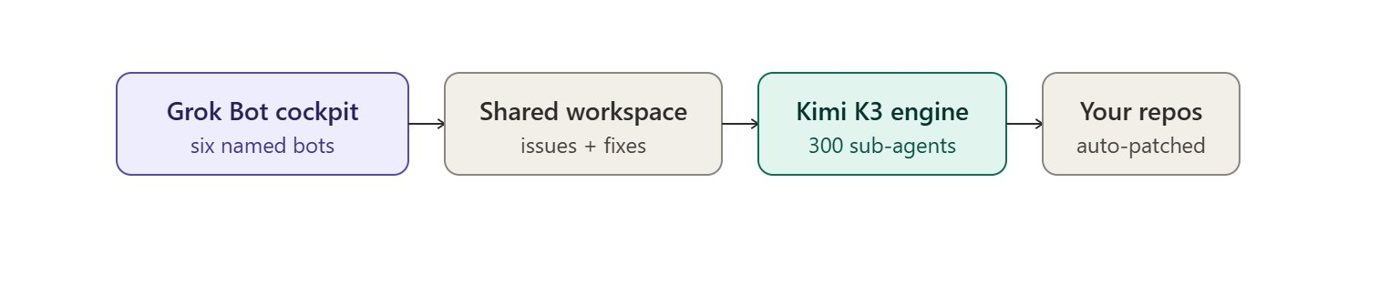
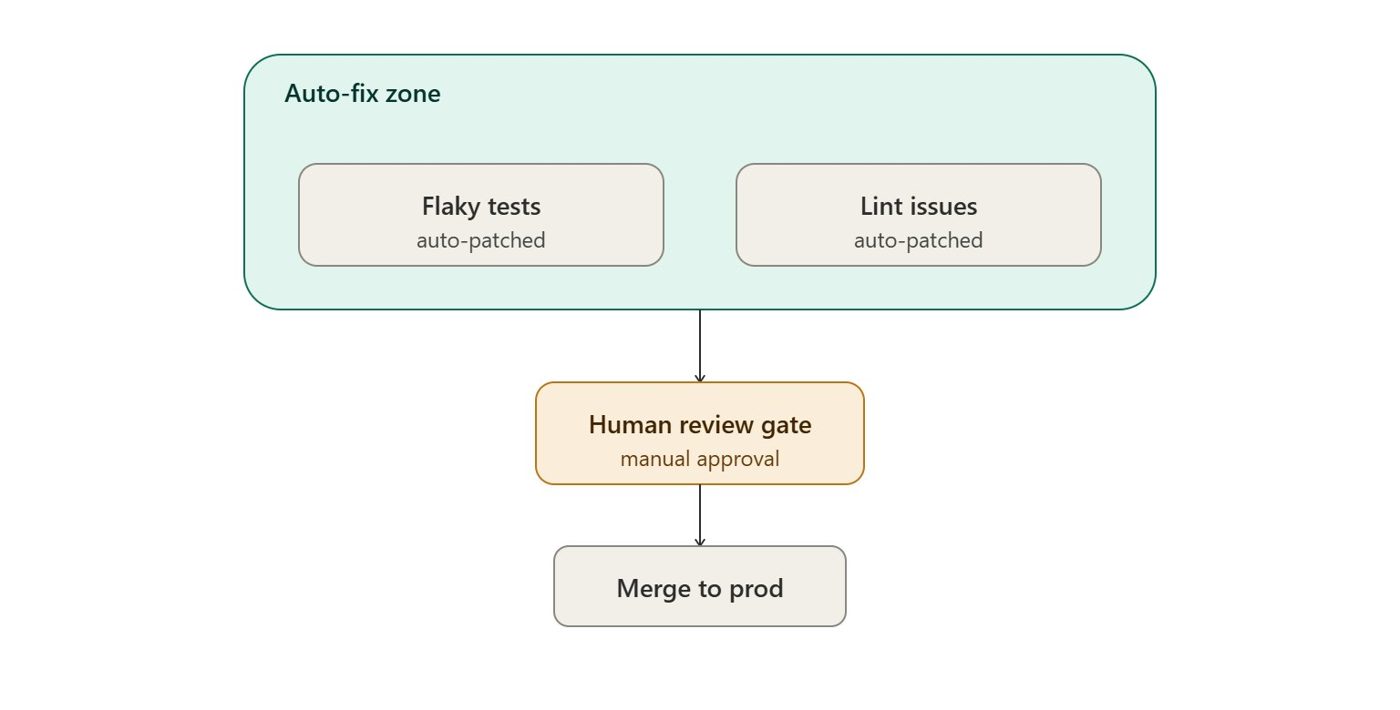
The architecture uses Grok Bot as the interactive master console, backed by Kimi K3 to handle concurrent anomaly monitoring. Claiming to run up to 300 sub-Agents on a single machine, a total of 6 named Bots are deployed.
- Fix Bot reads the backlog of fixes, focusing exclusively on flaky tests and formatting standards, and automatically opens Draft PRs.
- Scripts never touch business logic, and only submit drafts for review, never automatically merging into the main branch.
- Run in low-risk, peripheral repositories for a week first, and decide whether to expand based on the patch adoption rate.
Grok Bot + Opus 5.5: The Ultimate Agent Harness in 10 Steps|Morlex
Source: Grok Bot + Opus 5.5: The Ultimate Agent Harness in 10 Steps
Author: Morlex @0xMorlex
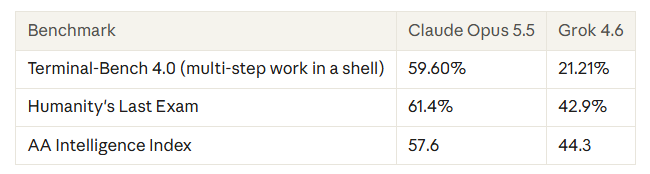
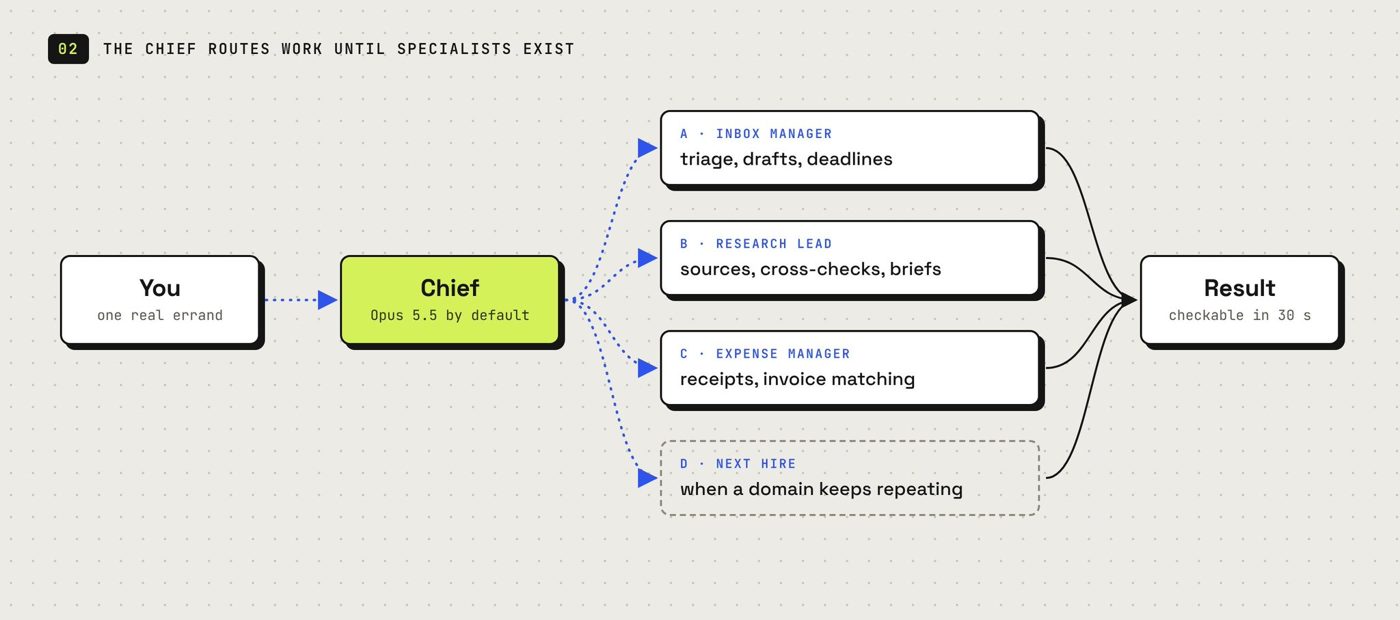
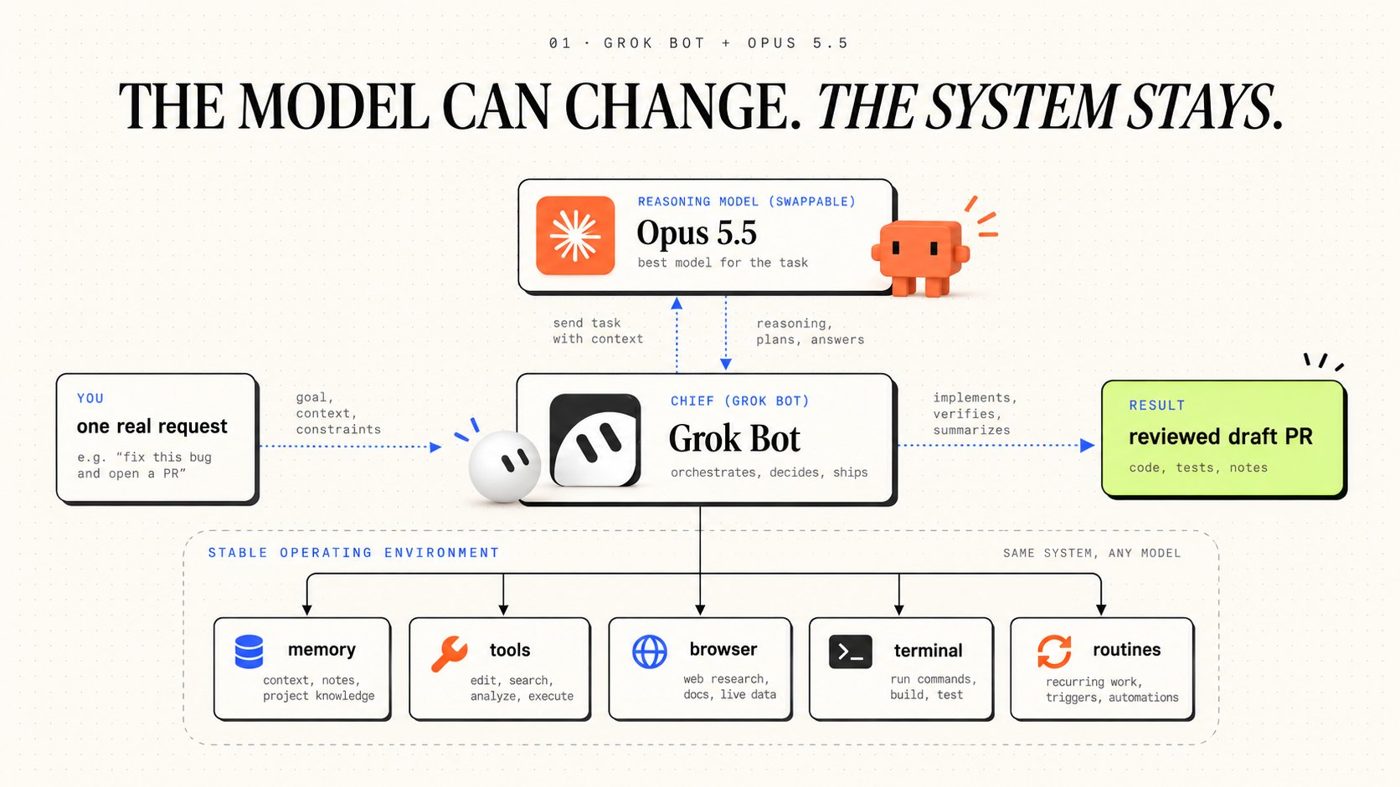
After Grok Bot integrated Claude Opus 5.5, Morlex outlined a 10-step configuration methodology, focusing on establishing human checkpoints based on operational reversibility.
- Structurally, the general-purpose Bot Chief orchestrates the system, dispatching specialized Bots by business function and coordinating with Cursor cloud Agents for collaborative coding.
- Retrieval, formatting, and drafting are executed autonomously by the Bot; any actions involving external messaging or fund transfers must halt for human approval.
- Establish strict red lines prohibiting Bots from searching financial directories, legal documents, and sensitive keys.
Grok Bot + Opus 5.5: Build a 24/7 AI Engineering Team in 12 Steps
Source: Grok Bot + Opus 5.5: Build a 24/7 AI Engineering Team in 12 Steps
Author: Mori @0xjmori
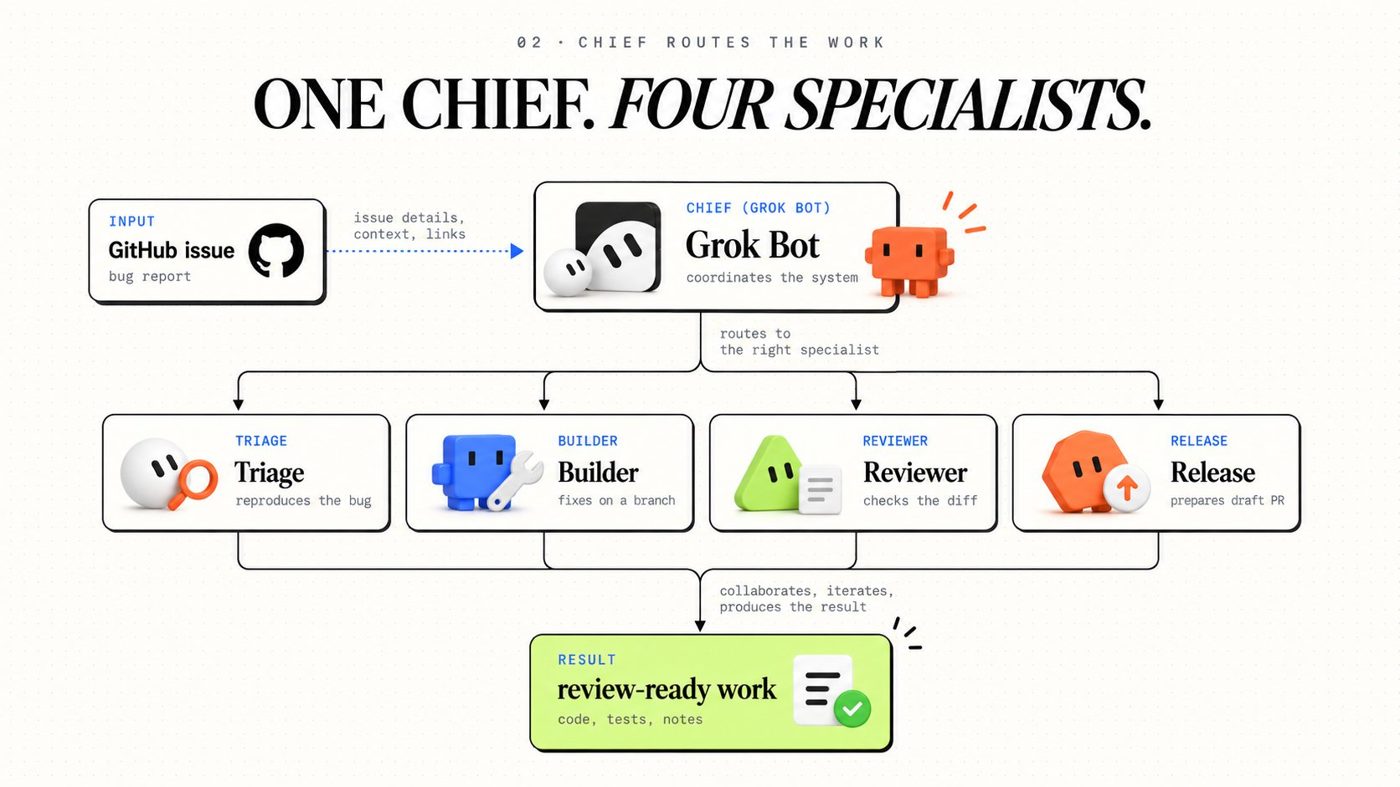 Mori runs a state machine in
/workspace/devdesk on the cloud computer to fix GitHub issues, with Chief orchestrating four dedicated roles to drive progress:
- Triage reproduces issues and provides failing test cases.
- Builder invokes Cursor cloud Agents to write patches on isolated branches.
- Reviewer conducts independent reviews and hands off to Release for publishing.
- Acceptance: Patch delivery must include execution logs comparing before-and-after results of reproduction test cases.
- Circuit breaker: Halt immediately and notify a human if the same test fails twice, preventing infinite loops from draining quotas.
Team Architecture and Role Decomposition
The core of multi-Bot collaboration lies in clarifying organizational structure. Many teams see efficiency drop after creating multiple Bots—the root cause is overlapping role boundaries, the absence of a unified dispatch entry point, and mistaking one-off chat experiences for long-term systems.
GrokBot Agents: build a team that works for you 24/7 in 10 steps (Full-Course)|Movez
Source: GrokBot Agents: build a team that works for you 24/7 in 10 steps (Full-Course)
Author: Movez @0xMovez
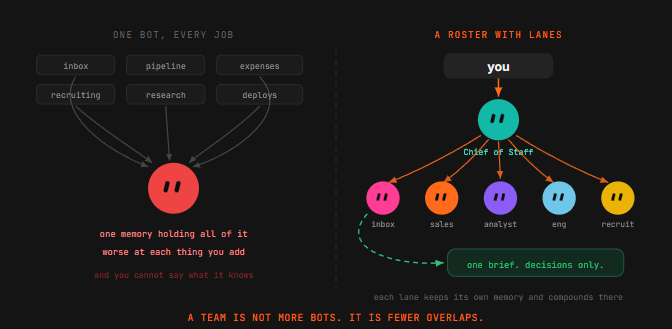
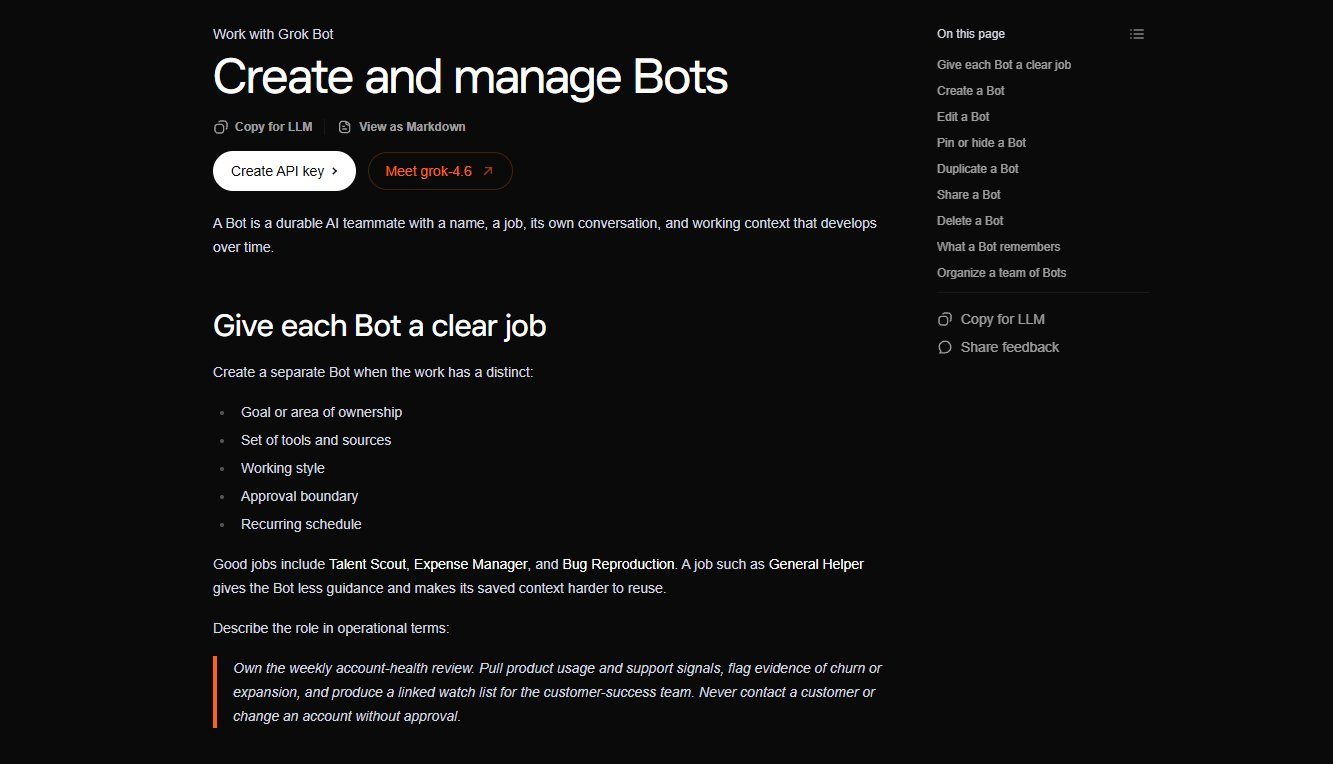
Piling all tasks onto a single Bot often leads to mounting chaos. Movez breaks down SpaceXAI's 9-seat Agent architecture, offering a 7-step path from one-off experimentation to permanent routines.
- 5 split signals: Spin off a new Bot when objectives and tools diverge, or when styles, schedules, and approval boundaries differ.
- Assign a dedicated Chief of Staff: Manages only calendars and inboxes, maintains a dynamic list based on real interactions, and stays silent during normal operations.
- Enforce two strict red lines: Throw errors immediately on missing or expired data, with fabrication strictly prohibited; never enable scheduled routines before establishing retry logic and failure boundaries.
Grok Bot: How to Hire Your First AI Employee (Full Guide)|distort
Source: Grok Bot: How to Hire Your First AI Employee (Full Guide)
Author: distort @distortgeekin
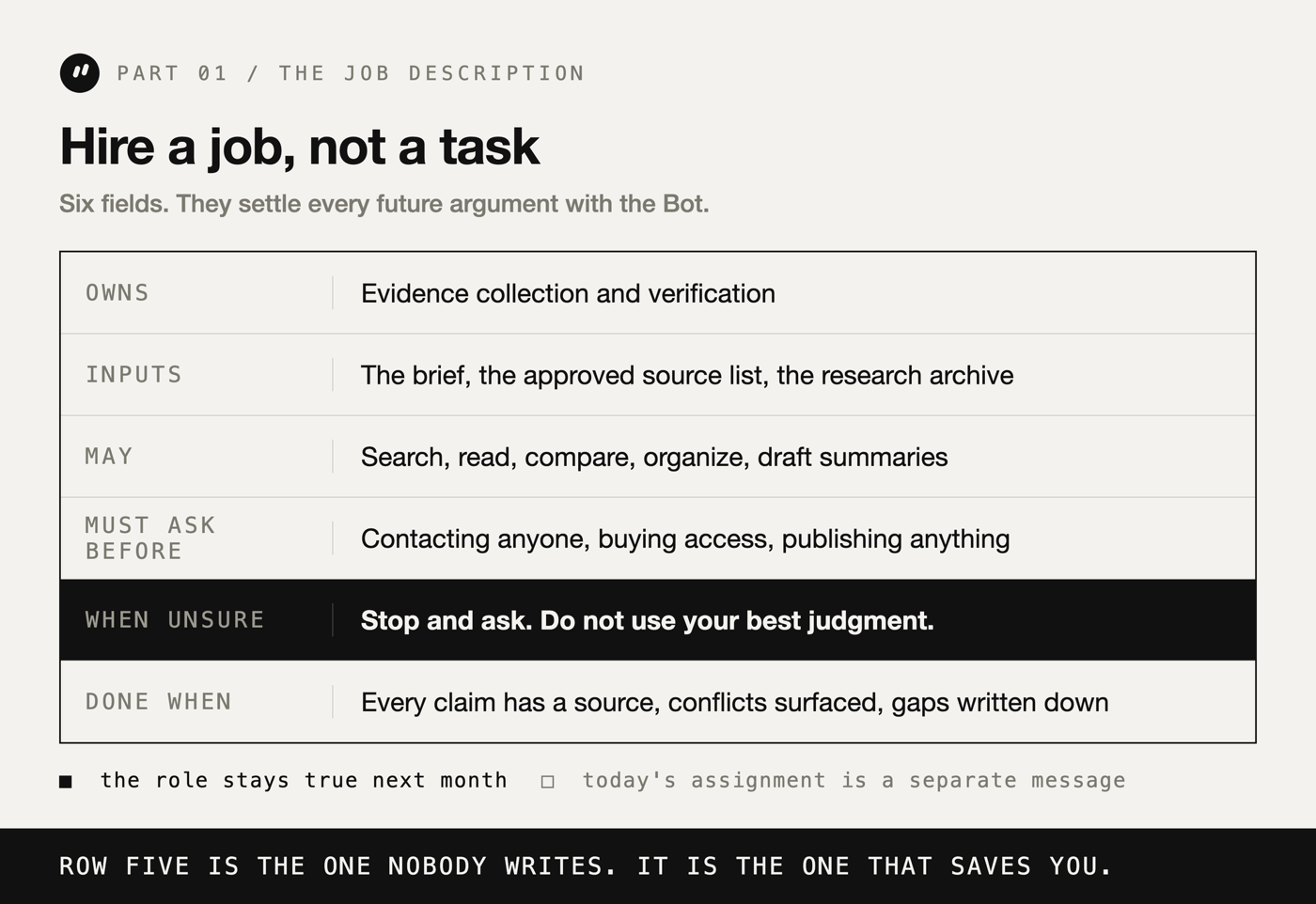
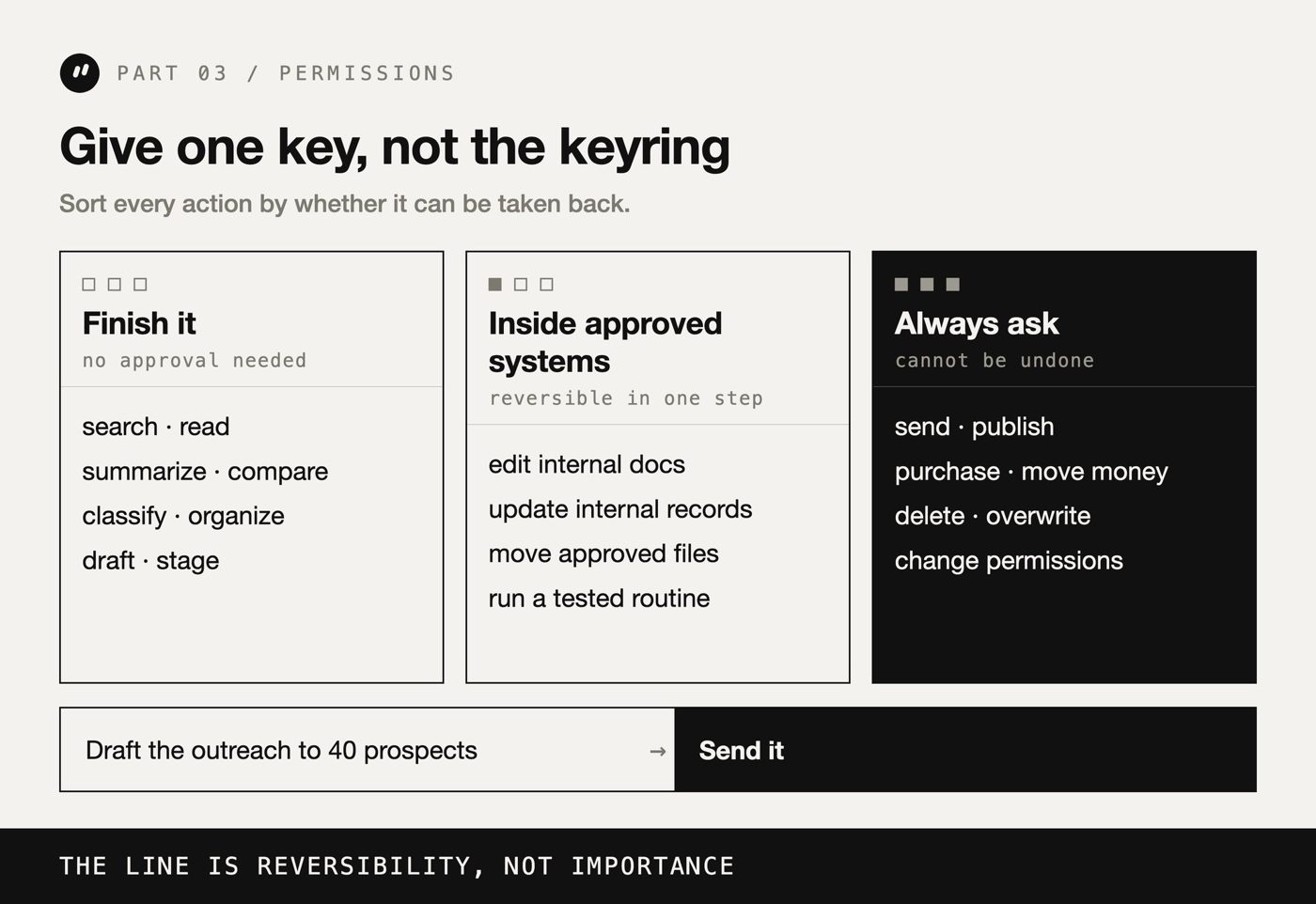
The Profile must include five fields: Owns, Inputs, May, Must ask before, and Done when.
Onboarding it takes four steps:
- Define responsibilities in a single sentence, starting with high-frequency, easily reversible chores.
- Conduct text-only walkthroughs of steps and uncertainties before execution.
- Complete three rounds of testing: observe, refine rules, and let go.
- Delegate permissions based on action reversibility: allow autonomous handling of research and drafts, but strictly enforce human approval for irreversible actions.
Delivery and acceptance must strictly uphold the bottom line: stop and ask when uncertain, and never guess in the dark.
Grok Bot: How to Build Your First AI Team (Full Guide)
Source: Grok Bot: How to Build Your First AI Team (Full Guide)
Author: distort @distortgeekin
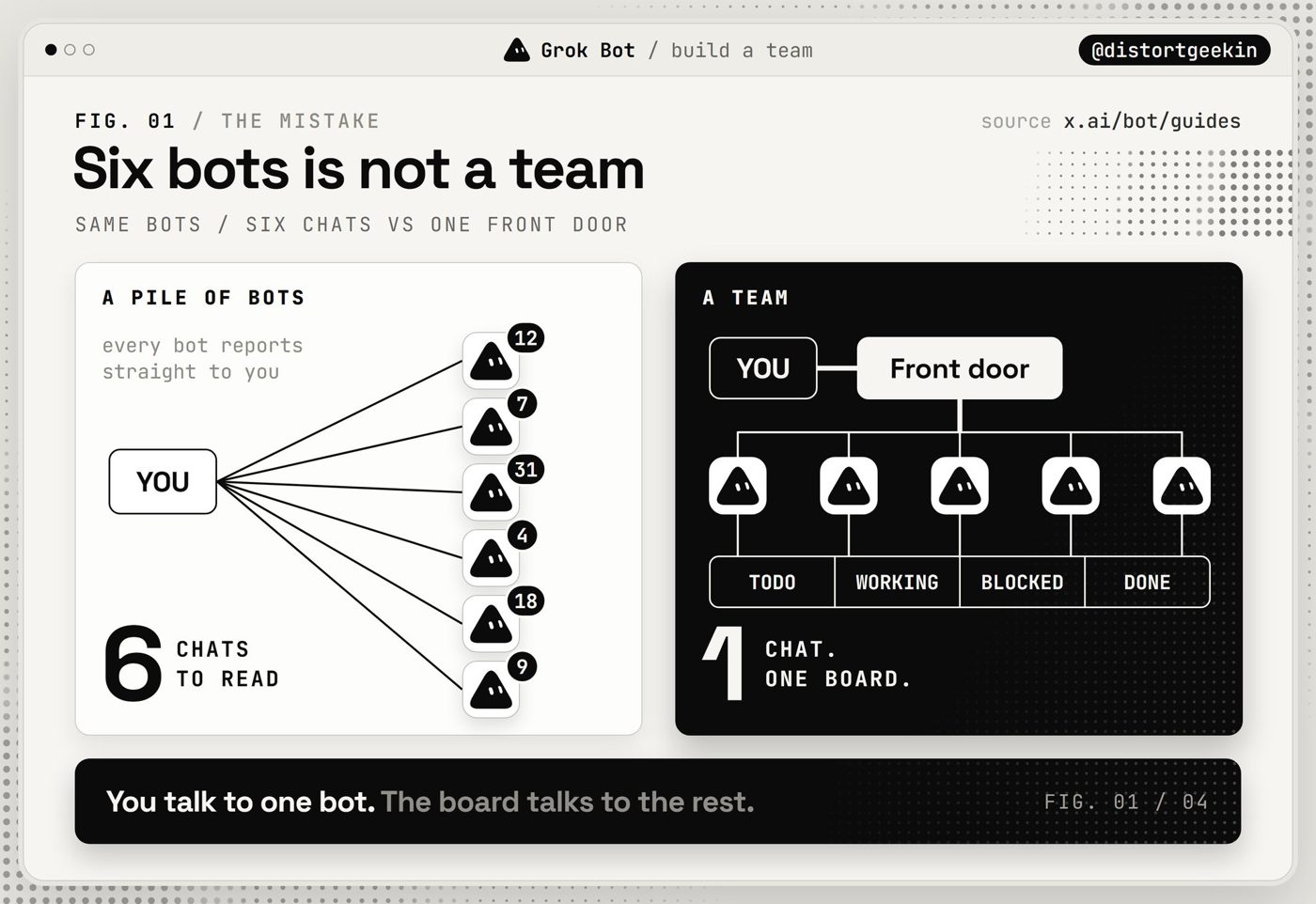
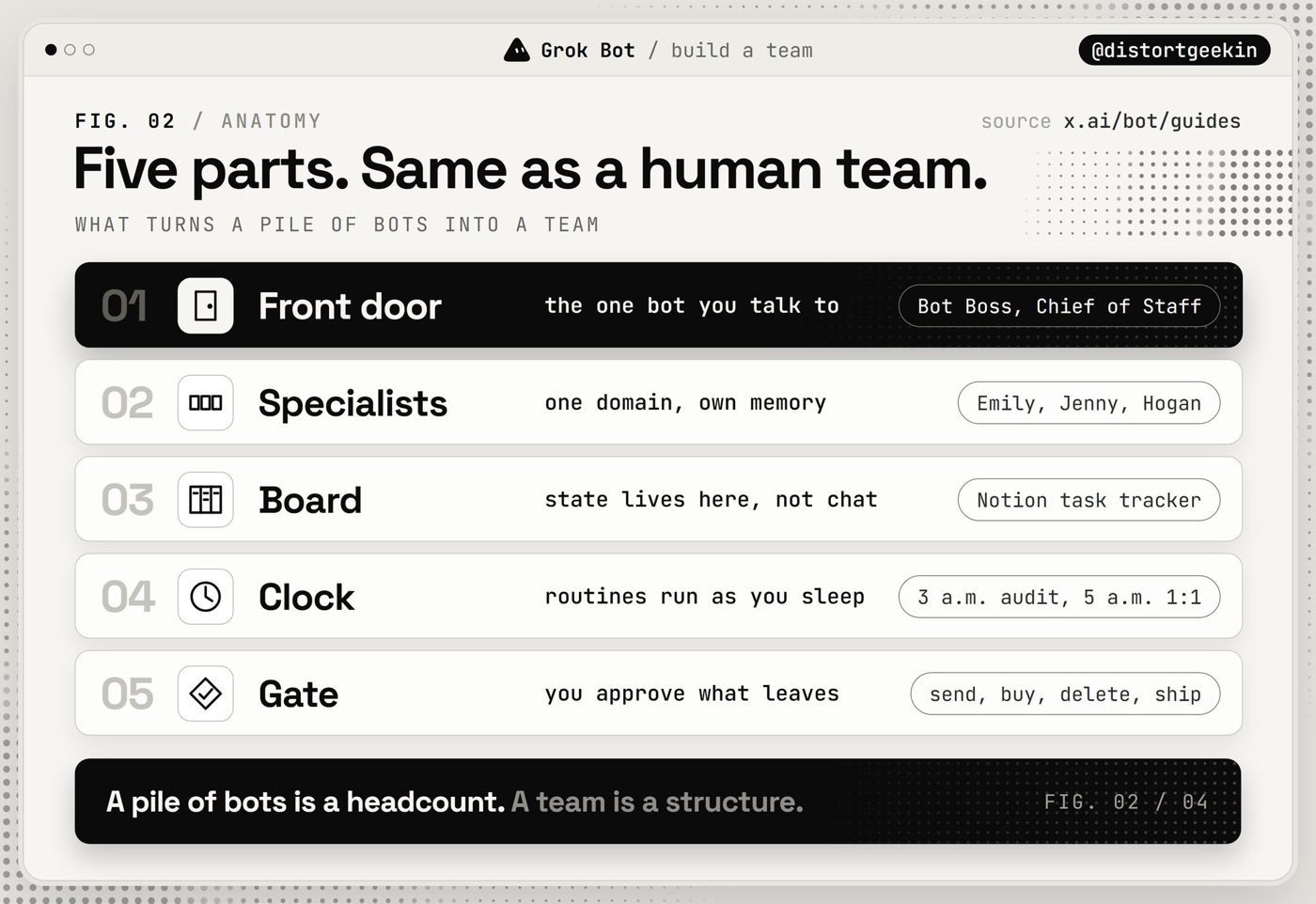 distort shared an architecture using 6 Bots to drive high-concurrency business (self-reported over 2,000 merged PRs in a single month), serving as a practical reference for building a 3- to 6-Bot setup:
- Chief of Staff handles coordination: Acts as the single central interface and is strictly prohibited from writing code or executing specific tasks directly.
- Dedicated Bots divide business functions: Each maintains independent memory, advancing tasks tracked entirely on an online Kanban.
- Automated 5 AM standup: The ops Bot traverses each role to synchronize specifications, countering context drift through regular recalibration.
How I use Grok Bot: My team of 29 AI agents
Source: How I use Grok Bot: My team of 29 AI agents
Author: Melvin Vivas @melvindvivas Melvin Vivas (@melvindvivas) uses coordinator Emma to connect 29 Agents (self-reported, unverified), divided into 4 collaborative groups: Research, R&D, Content, and Business.
- When the Research Bot discovers a new model, Emma assigns the Code Bot to invoke Cursor cloud Agents to write examples and submit a GitHub PR.
- The Content team takes over to produce tutorial drafts, with all Bots exchanging assets via a shared cloud computer file system.
- Regularly audit and decommission unused tasks to prevent multi-Bot setups from driving idle background consumption.
One-Person Company and Practical Prompts
10 Role Prompt Sets|maestro
Source: Top 10 Grok Bot Prompts That Replace an Entire Team
Author: maestro @maestrooth
This collection of ready-to-use prompts covers 10 scenarios including sales outreach, resume screening, and contract review. Bots only produce drafts, diffs, or curated lists, never crossing the red line of external execution.
- Risk isolation: When multiple Bots share the same cloud computer environment, dedicated email addresses and separate card numbers must be used.
- Acceptance criteria: Factual statements must include original web links; discard directly if unsupported by evidence.
- Defense mechanism: Global rules are embedded into a 5-line defense; upon completing each run, it must report the count of processed items, skipped items, and specific errors.
One-Person Company Operational Harness|beamnxw ./
Source: Grok Bot Engineering: Set Up a Harness for Your One-Person Company
Author: beamnxw ./ @beamnxw
Centered around the Operator, this harness uses a single-source brief to lock down pricing, target audience, and approval baselines, paired with a 6-field Kanban to track workflows.
- Reduce duplication: The single-source business brief serves as the behavioral baseline, eliminating the need to repeatedly brief background context for every delegated task.
- Human oversight: Proactively suspend execution before irreversible actions, keeping critical decisions in human hands.
- Daily inspections: Proven workflows are codified into standard Skills, automatically inspecting the Kanban at 9 AM on business days via Routines.
Memory Engineering and Cost Control
Once Bots are integrated into team collaboration and scheduled routines, the most common pitfalls are corrupted memory and runaway usage quotas. Only by establishing layered memory and disciplined scheduling can the system sustain long-term operation.
Meet your Team Bots|n2parko
Source: Meet your Team Bots
Author: n2parko @n2parko
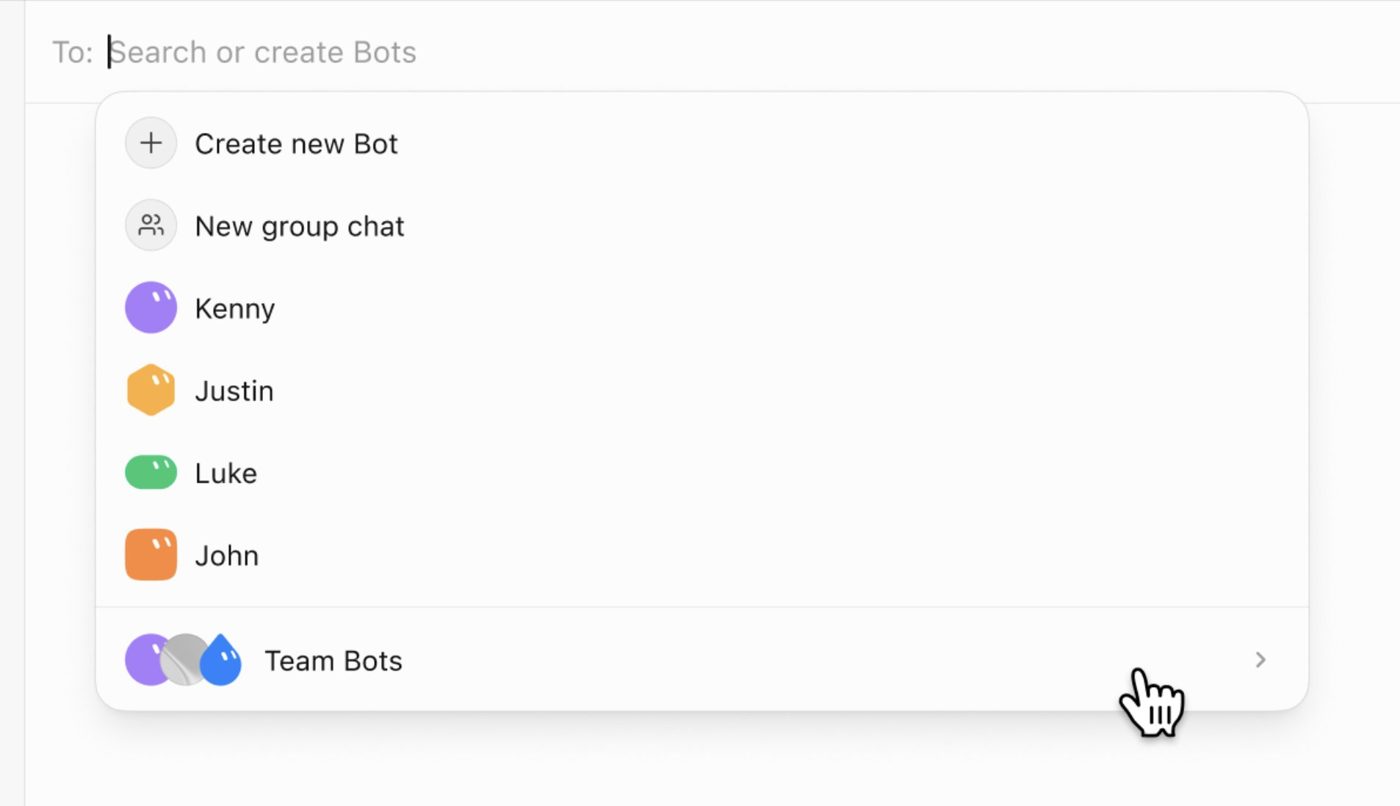
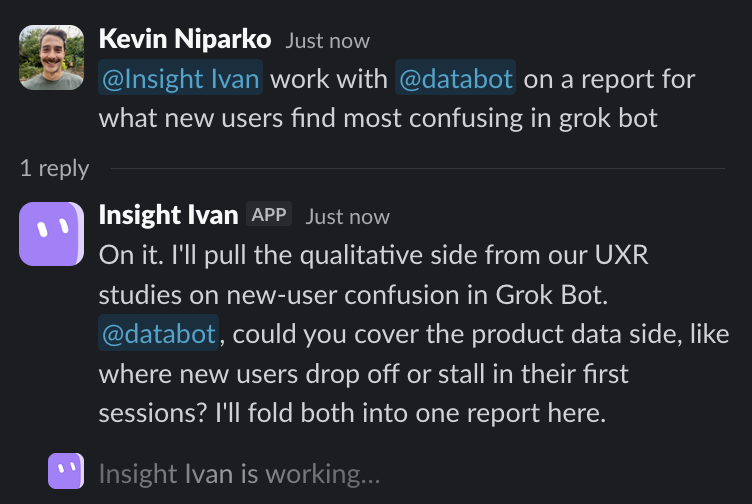 n2parko (@n2parko) introduces the official Team Bots feature, ideal for leads looking to preserve proprietary knowledge and reduce high-frequency inquiries. Running on Web and Slack, this system features a two-tier mechanism combining global team memory with isolated personal notes.
- Domain experts build dedicated Bots: The SpaceXAI data team created Databot, versed in data lakes and visualization (self-reported coverage of over 45,000 tables, unverified), deflecting a vast amount of routine queries for experts; engineering and marketing also set up dedicated Bots to align workflows.
- Consolidate expertise: Solidify tacit knowledge from business experts into shared tooling while preserving personal interaction privacy.
How to Stop Your Grok Bot From Eating a Week of Usage in a Day|Fan Grok Bot Radar
Source: How to Stop Your Grok Bot From Eating a Week of Usage in a Day
Author: Fan Grok Bot Radar @GrokBotRadar
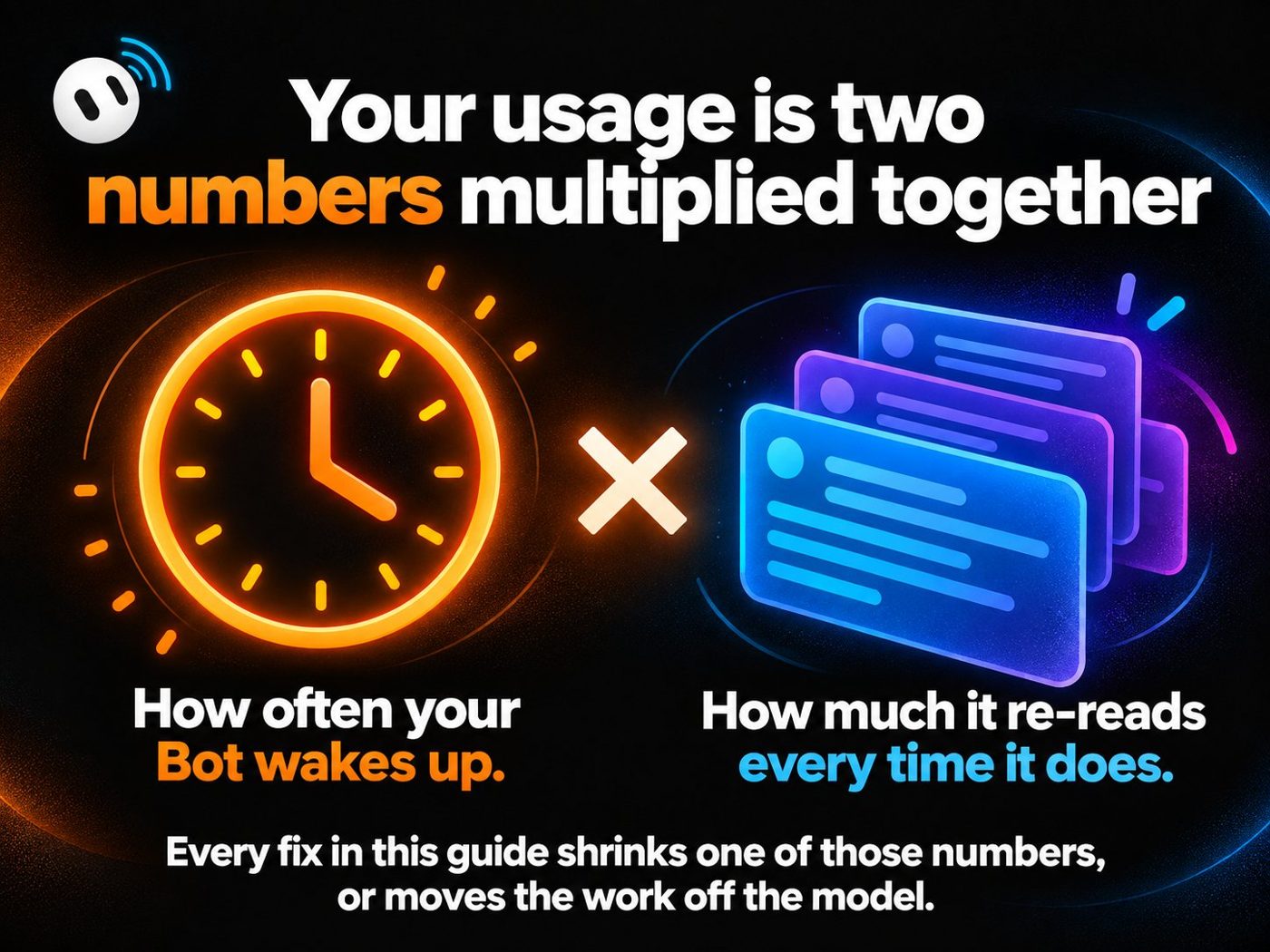
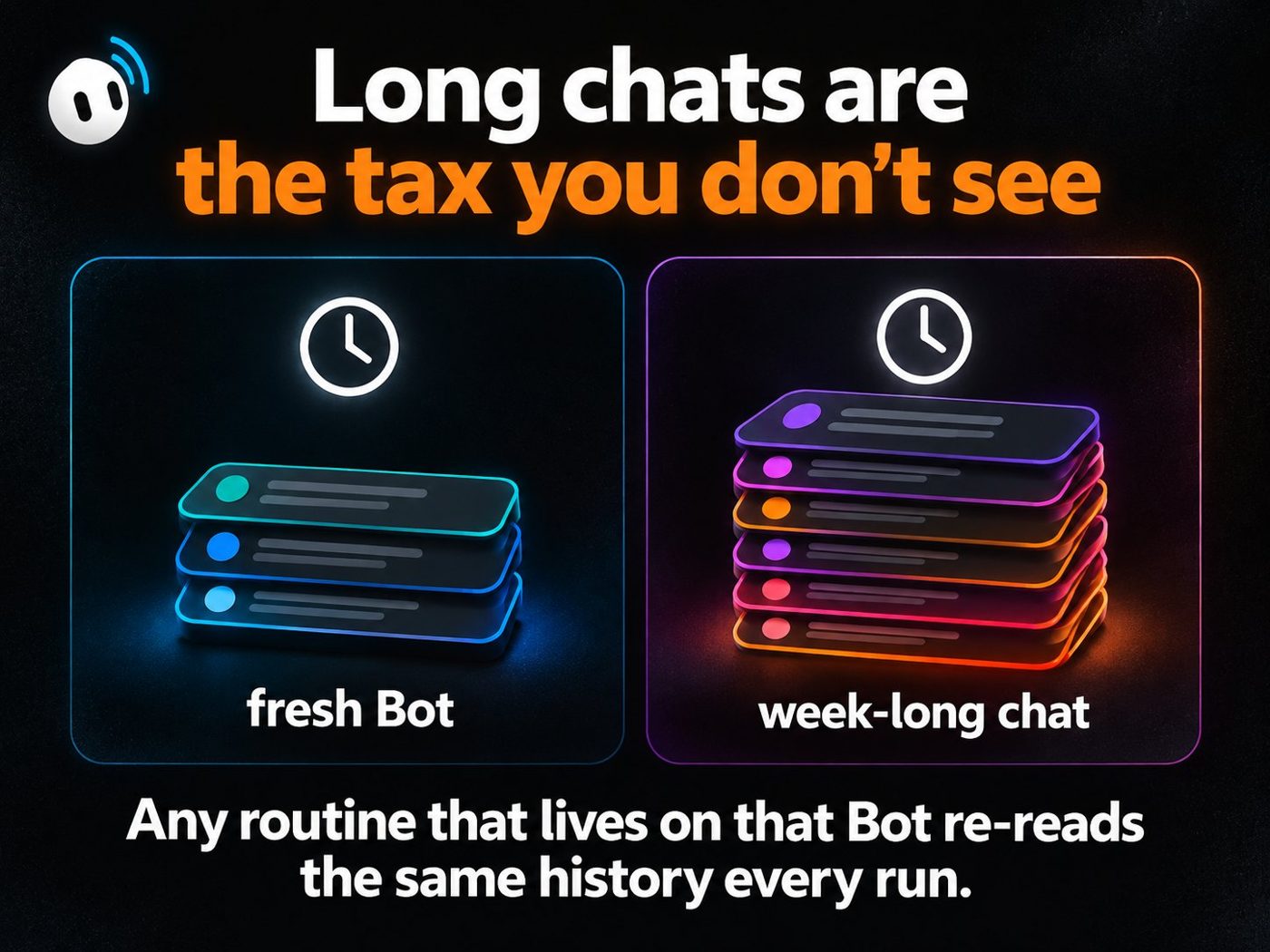 Fan Grok Bot Radar (@GrokBotRadar) discovered that token usage fundamentally equals wake-up frequency multiplied by re-reading the entire historical context each time, as every trigger re-reads the full conversation history. The author provides five actionable tips to reduce consumption:
- Compress frequency: Reduce all-day 15-minute polling to scheduled checks during business hours.
- Sever history: Periodically use Duplicate to clone the Bot and reset history (self-reported per-run token reduction of ~75%, unverified).
- Physical separation: Deploy high-frequency chat Bots and routine-running Bots separately.
- Offload to scripts: Delegate deterministic chores like email filtering to Python scripts running in the cloud computer terminal.
- Acceptance criteria: Add silence rules to monitoring routines, ensuring zero useless messages are generated when there are no anomalies.
Grok Bot Memory Engineering: How One Agent Learns With a Team|rari
Source: Grok Bot Memory Engineering: How One Agent Learns With a Team
Author: rari @0xwhrrari
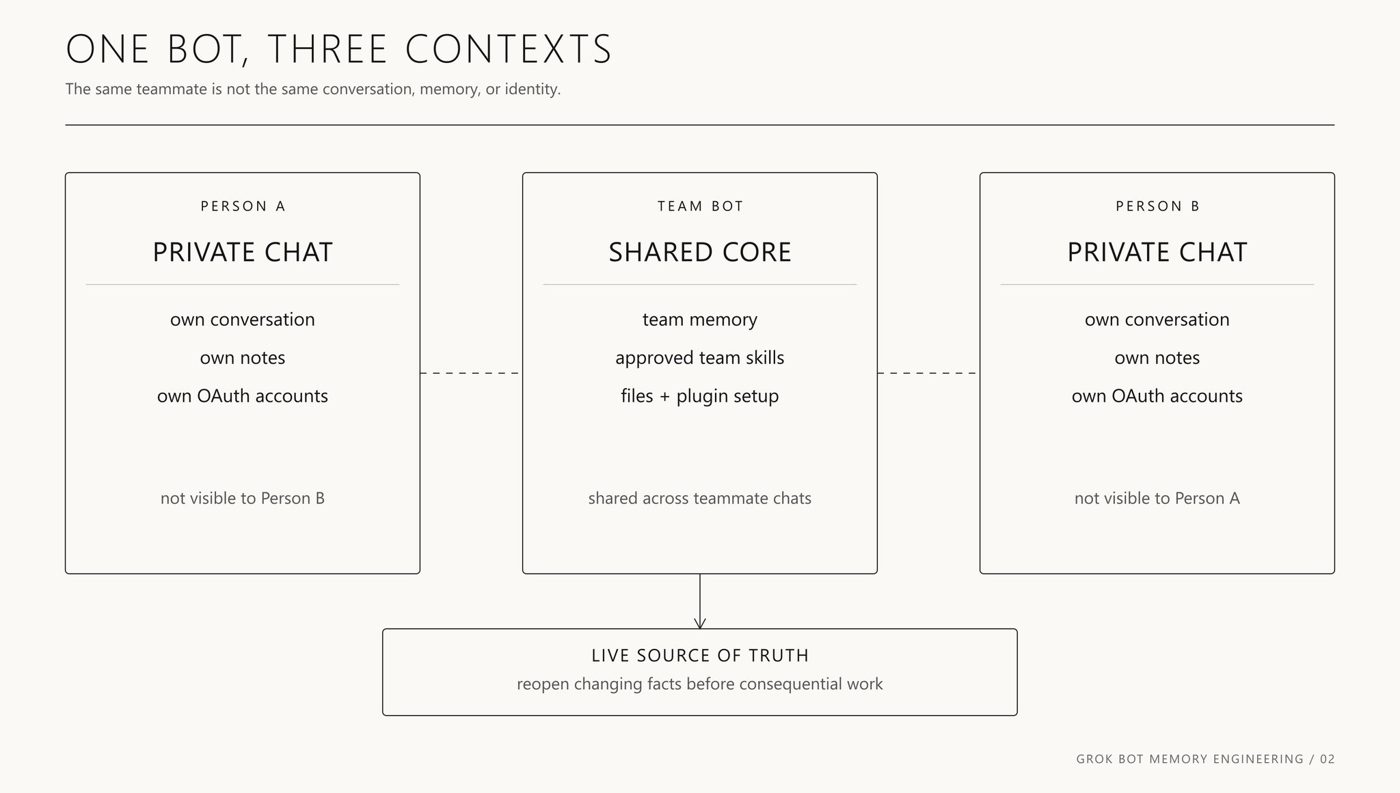
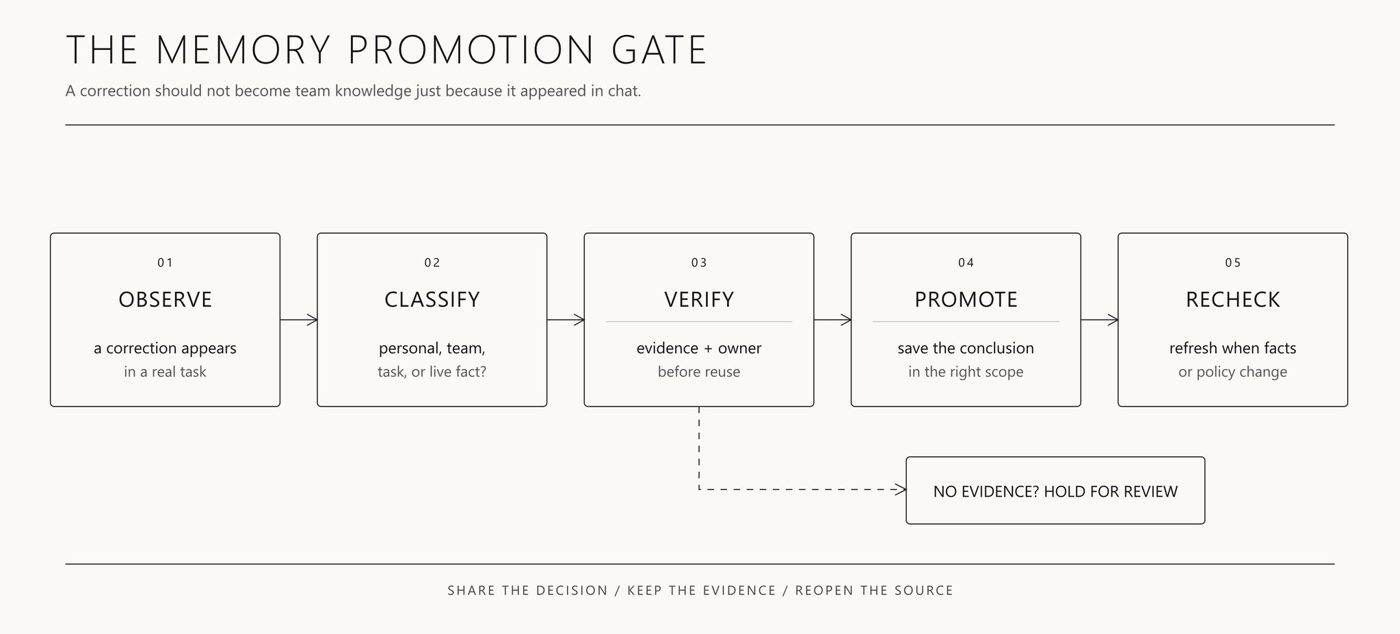 rari's (@0xwhrrari) architecture specifically addresses memory pollution when multiple people share a Bot, making it ideal for engineering architects. He divides context into five container types to house real-time sources, skills, team memory, personal notes, and task states.
- Fast/slow clock bifurcation: Slow-clock information like tone is stored in team memory; fast-clock data like pricing and inventory must be queried from source systems in real time every run.
- Review cards: Clearly label the owner, source, and expiration date; writing to the shared pool is permitted only after approval.
- Acceptance defense: Test cross-user privacy leaks and channel permission boundaries prior to production rollout, treating corrupted memories as data incidents requiring rigorous investigation and rollback.